

Areopagus Volume CXI
Seven short lessons every someday.

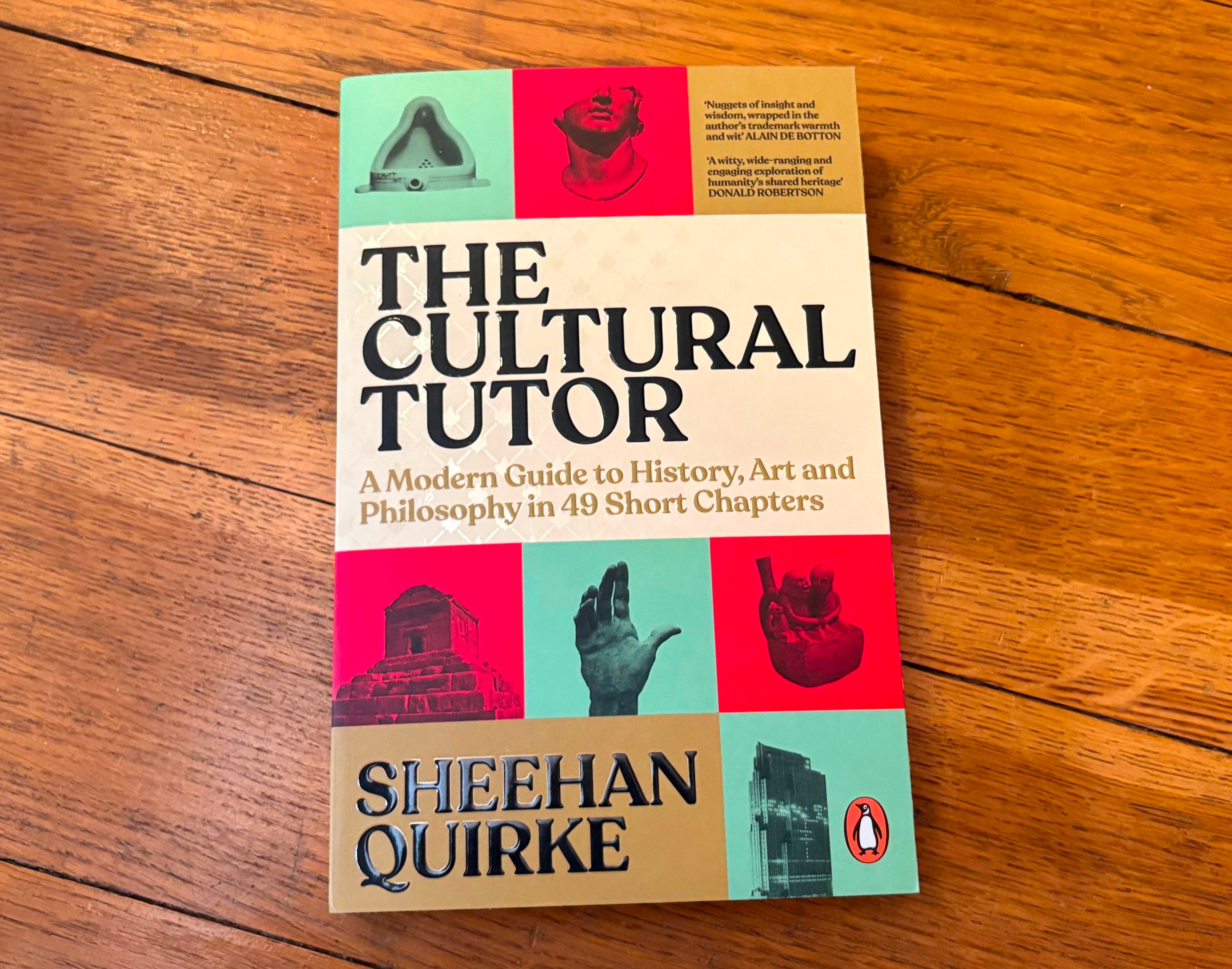
Welcome one and all to the hundred-and-eleventh volume of the Areopagus, arriving with news that is, in this rare case, quite literally hot off the press: the paperback edition of my book is out now! There’s a fetching new cover and subtitle, and you can order a copy here, or at any of the places you usually buy your books; there’s also 25% with Waterstones.
Now for the Areopagus. Marcel Proust (whose In Search of Lost Time I’ve (finally) been reading) has put me in the mood for remembering things past and otherwise overlooked. That’s our destination, and a few lines from Charles Baudelaire’s Le Voyage, translated by Edna St. Vincent Millay, will be our embarkation:
Astonishing voyagers! What splendid stories
We read in your eyes as deep as the seas!
Show us the chest of your rich memories,
Those marvelous jewels, made of ether and stars.We wish to voyage without steam and without sails!
To brighten the ennui of our prisons,
Make your memories, framed in their horizons,
Pass across our minds stretched like canvasses.Tell us what you have seen.
Time to weigh anchor, setting sail on the seas of time!
I - Classical Music
“Cara, non dubitar” from The Secret Marriage
Domenico Cimarosa (1793)
Performed by Leopold Simoneau and Pierrette Alarie with the Deutsches Symphonie-Orchester Berlin
The Teatro della Scala in Milan by Carlo Bossoli (1849)
Recently, and for the first time, I found time for Stendhal. He’s a writer I’ve heard lots about, and whose novels’ alluring titles (The Charterhouse of Parma; Scarlet and Black) I’ve seen in bookshops for years. Suffice to say that Stendhal lived up to his enormous reputation and I was delighted by his company. Now, and more to the point, Stendhal loved music; alongside his novels he wrote a biography of Giachino Rossini and his novels are filled with musical allusions. In The Charterhouse of Parma, for example, Milan’s La Scala is a crucial location. The taste of an author so vaunted, and one so renowned for musical erudition, is surely worth exploring.
So: who was Stendhal’s favourite composer? Domenico Cimarosa. Strange, perhaps, that the name of a man who wrote more than sixty operas performed all around Europe, who was more popular than Mozart, and whose talents were so prized that he served as court composer for both Leopold II (of the Holy Roman Empire) and Catherine the Great (of the Russian Empire), should be totally unfamiliar to us!
What I have shared is a duet called Cara, non dubitar (“Dear, don’t doubt”) from Cimarosa’s The Secret Marriage, a comic opera which opened to blockbuster success in 1793. Stendhal claimed to have seen it more than one hundred times, and it’s one of few works by Cimarosa that hasn’t completely faded from memory, with partial and occasionally full performances taking place every few years, though usually at festivals or by regional opera groups rather than major venues.
What else has survived? This is where the story of Cimarosa (and Stendhal’s love for him) becomes rather interesting. Much more popular than The Secret Marriage (and with millions of views or streams across YouTube and Spotify) is Cimarosa’s Concerto for Oboe in C Minor. But this piece was actually created in 1942 by the Australian composer Arthur Benjamin, who selected and rearranged certain passages from Cimarosa’s piano sonatas.
What makes this even more peculiar is that Stendhal never mentioned Cimarosa’s piano sonatas. Why? Because they were only discovered in the 1920s, in a trove of a manuscripts uncovered in Florence. Despite going unpublished during his lifetime, it is these sonatas have ensured Cimarosa’s survival. A rearrangement of Piano Sonata 42 by the Icelandic pianist Víkingur Ólafsson, for example, has been played thirty-six million times on Spotify. The strangest thing about all this, of course, is that the man who loved Cimarosa most — our Stendhal — would, alongside being thrilled to know that people are still listening to his music in the 21st century, be baffled to learn that he’d never heard the music for which Cimarosa is now known. Who knows what unreleased or obscure tracks our current musical superstars, much to our surprise, may be remembered for in the future?
II - Historical Figure
Samuel Daniel
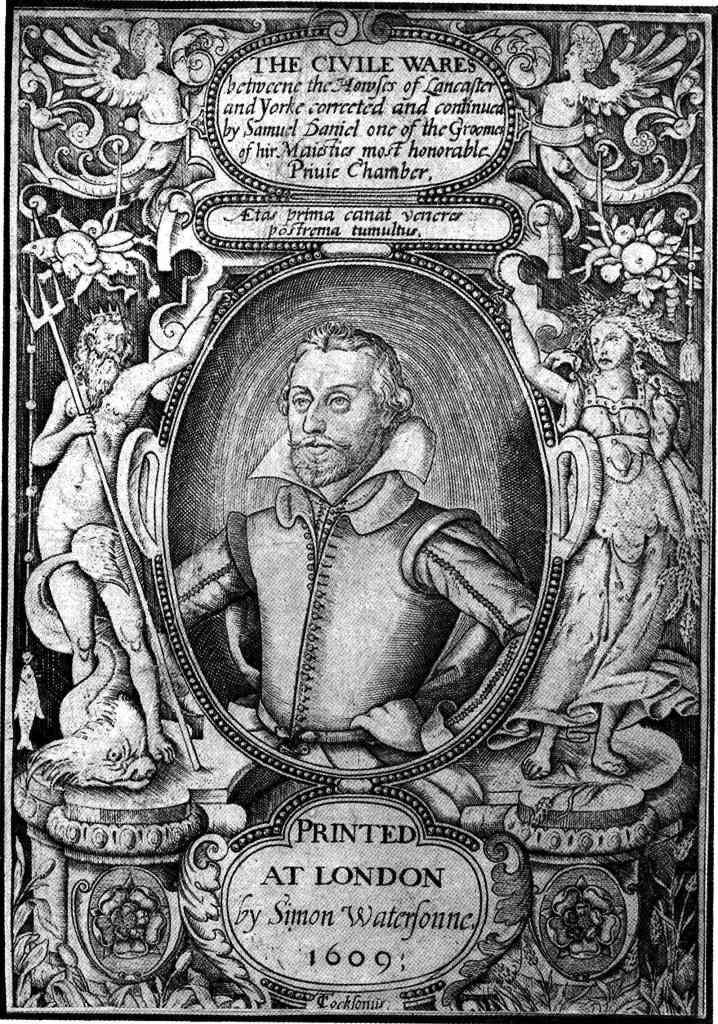
The poet Samuel Daniel is, in the grand scheme of things, a minor figure in the long history of English art and language. Nonetheless, he was both an immensely successful writer and an important contributor to a major debate that has since shaped how we all write and talk (and therefore, really, think). He was born in 1562 and died in 1619, living cosynchronously with Shakespeare and taking part, alongside him, as a leading light in the Elizabeth and Jacobean flowering of English literature.
In 1602, against the backdrop of this flowering, a fellow poet called Thomas Campion wrote a short treatise called Observations on the Art of English Poesie. It was an all-out attack on the use of rhyme. Campion argued that, instead of relying on rhyme and stressed metre (i.e. where each line has a set number of syllables), poets should use write rhymelessly and with quantitative metre, whereby syllables are measured by how long it takes to say them, as in Ancient Greek or Italian poetry. Samuel Daniel, encouraged by his friends (to whom he had written private letters on the subject) published a response to Campion’s treatise, calling it A Defence of Rhyme.
These two tracts were part of a larger contemporary debate about the English language and whether it should develop on the foundation of Ancient Greek and Roman literature or whether local and more recent innovations should be allowed to flourish. Though it seems rather pedantic and recondite now, this question was once of the utmost significance; no doubt future generations will look back on our debates around language and the arts, which seem vitally important to us, as similarly trifling. But, even within these apparent trifles, there are treasures to be found!
Daniel’s treatise is striking, at first, because of his readiness to criticise Antiquity. As, for example, when he says of Roman poets:
…their boundlesse running on, often so confounds the Reader, that having once lost himselfe, must either give off unsatisfied, or uncertainely cast backe to retrieve the escaped sense, and to find way againe into his matter.
The past was not necessarily better than the present. Such was Daniel’s conviction; he rejected the idea that Greco-Roman culture had reached a state of perfection which his modern England was duty-bound to emulate:
Me thinkes we should not so soone yield our consents captive to the authoritie of Antiquitie, unlesse we saw more reason: all our understandings are not to be built by the square of Greece and Italie. We are the children of nature as well as they, we are not so placed out of the way of judgement but that the same Sunne of Discretion shineth uppon vs, wee have our portion of the same vertues as well as of the same vices.
Whereas Campion’s approach to the problem had been technical, Daniel turned to more general arguments; that is why, despite being an ostensibly hypercontextual treatise of exclusive value to literary historians, Daniel’s Defence of Rhyme somehow transforms into a timeless response to all those who would seek to shackle the present to the past, or to proclaim the superiority of one artistic method over another.
Thus he points out that China, despite not using the same poetic rules as the Ancient Greeks, was still a sophisticated, wealthy, and erudite nation:
Will not experience confute us, if wee shoulde say the state of China, which never heard of Anapestiques, Trochies, and Tribracques, were grosse, barbarous, and uncivile?
This expands into a broader attack on the idea that one particular culture could be considered artistically superior to another, and that certain forms of art are worse than others; greatness proliferates throughout all humankind, Daniel argued:
Nor can it be but a touch of arrogant ignorance, to hold this or that nation Barbarous, these or those times grosse, considering how this manifold creature man, wheresoever hee stand in the world, hath alwayes some disposition of worth, intertaines the order of societie, affects that which is most in use, and is eminent in some one thing or other, that fits his humour and the times.
And then, addressing the Renaissance’s foundational idea — that the Middle Ages were a time of barbarous darkness — Daniel says, with the same vein of humility and open-heartedness that runs throughout the whole treatise:
…it is but the clowds gathered about our owne judgement that makes us thinke all other ages wrapt up in mists, and the great distance betwixt us, that causes us to imagine men so farre off, to be so little in respect of our selves.
Wise words that are as necessary now, with forces of rampant futurism dismissing the past as irrelevant or burdensome, as they were in the year 1603.
Daniel was frustrated with highly educated men who produced more confusion than order by their erudition, and who seemed to prize pedantry over real understanding; here we find echoes of the charming common sense that defines the Essays of Michel de Montaigne. He believed that if people have been doing something and it works well, there’s no need to philosophise ourselves out of accepting it:
I thanke God that I am none of these great Schollers, if thus their high knowledges doe but give them more eyes to looke out into uncertaintie and confusion, accounting my selfe, rather beholding to my ignorance… plodding on the plaine tract I finde beaten by Custome and the Time, contenting me with what I see in use.
Nonetheless, Daniel’s argument wasn’t a nihilistic or relativistic rejection of the idea that great art exists; he evidently believed in the permanent and universal power of art. Rather, Daniel recognised that each era has its own idiosyncrasies, systems, and fashions, and that these things shape what is considered “good” at any given period in time. Therefore, he reasoned, it would be wrong to teach that any particular approach to poetry — rhymed or unrhymed — was absolutely correct:
I dare not take upon mee to teach that they ought to be so, in respect my selfe holdes them to be so, or that I thinke it right; for indeede there is no right in these things that are continually in a wand’ring motion, carried with the violence of our uncertaine likings, being but onely the time that gives them their power.
What Daniel saw was the goodness in all things, of all ages and places, which cannot be reduced to a set of frozen maxims of rules, but (like our ever-changing selves) must be adapted to circumstance and context.
Daniel’s name has lost its lustre, but, and even invisibly, his influence lives on and thrives in the books we still read and the very things we say. Languages are an ever-changing social possession, passed down from one generation to the next, with each generation altering what they’ve inherited. English as we know and write it today was, in some small but not insignificant way, shaped by Daniel.
But his own (relative) oblivion would not have surprised him; Daniel foresaw and predicted it, ending his Defence with these gorgeous, timeless, and humble words, calmly acknowledging that this great debate (which seemed so important to him and his contemporaries) would become a trifle, if not forgotten, soon enough.
…this is but a Character of that perpetuall reuolution which wee see to be in all things that neuer remaine the same, and we must heerein be content to submit our selves to the law of time, which in few yeeres wil make al that, for which we now contend, Nothing.
III - Art
Correggio
In London’s National Gallery, looking down from a screen of gilded spandrels and marble shafts at the top of its grand staircase, are three faces. They depict, from left to right (and with their names Latinised): Rembrandt, Leonardo, and Correggio.
The first two remain blockbuster names of art and culture, especially Leonardo. The third name, though known to lovers of art, will be otherwise unfamiliar. Millions of people pass through those doors every year, and if we could now choose three artists to welcome them, Correggio wouldn’t make the cut. So: who was he, and why was he once considered worthy of such an honour?
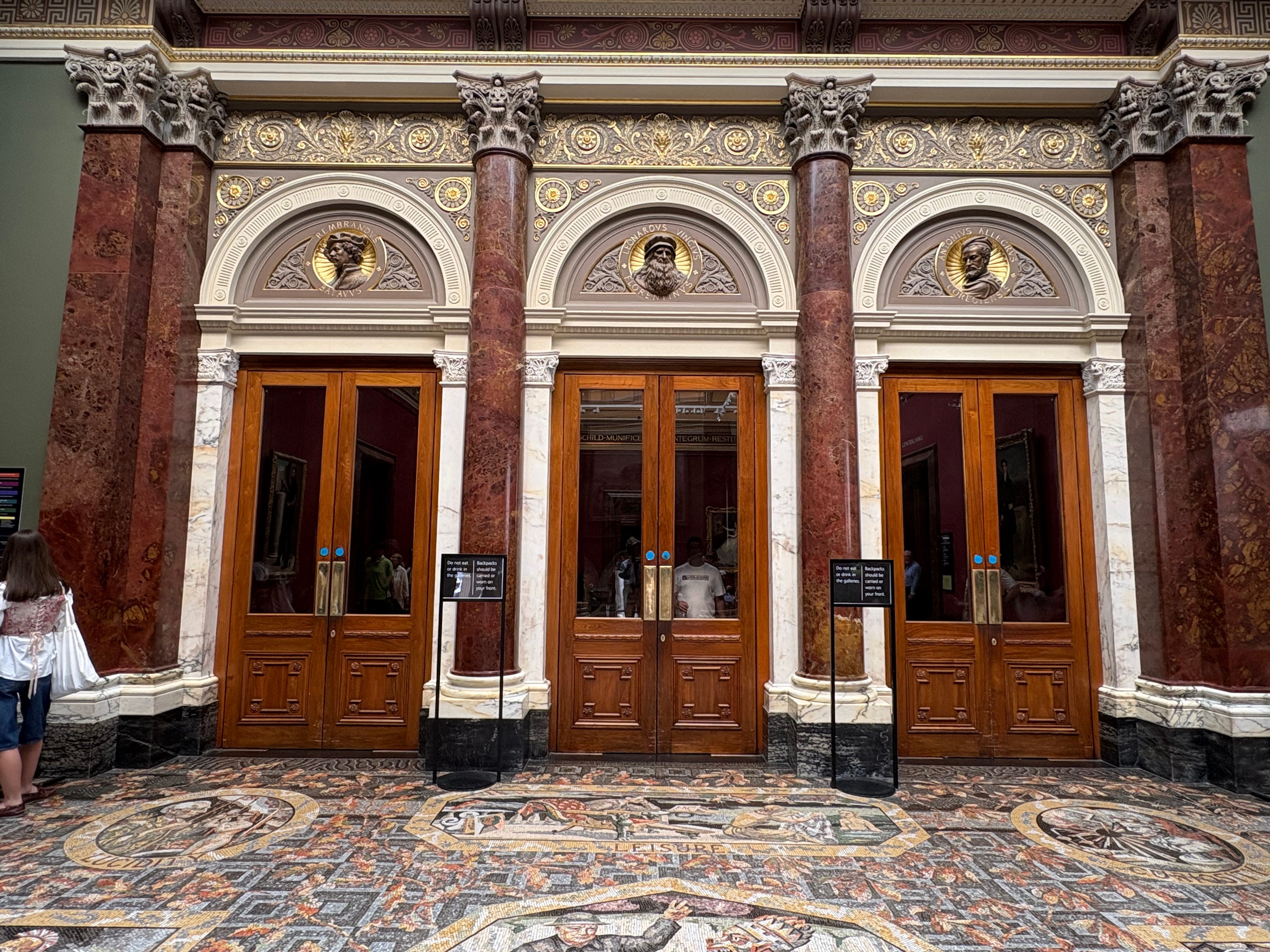
Antonio Allegri da Correggio was born in 1489 and died in 1534, at the age of forty-four. He worked in the Italian city of Parma and became its foremost painter during the High Renaissance, absorbing the influences of his contemporaries and pushing beyond the existing boundaries of Renaissance art, into the more extravagant and sensual realms of Mannerism and Baroque.
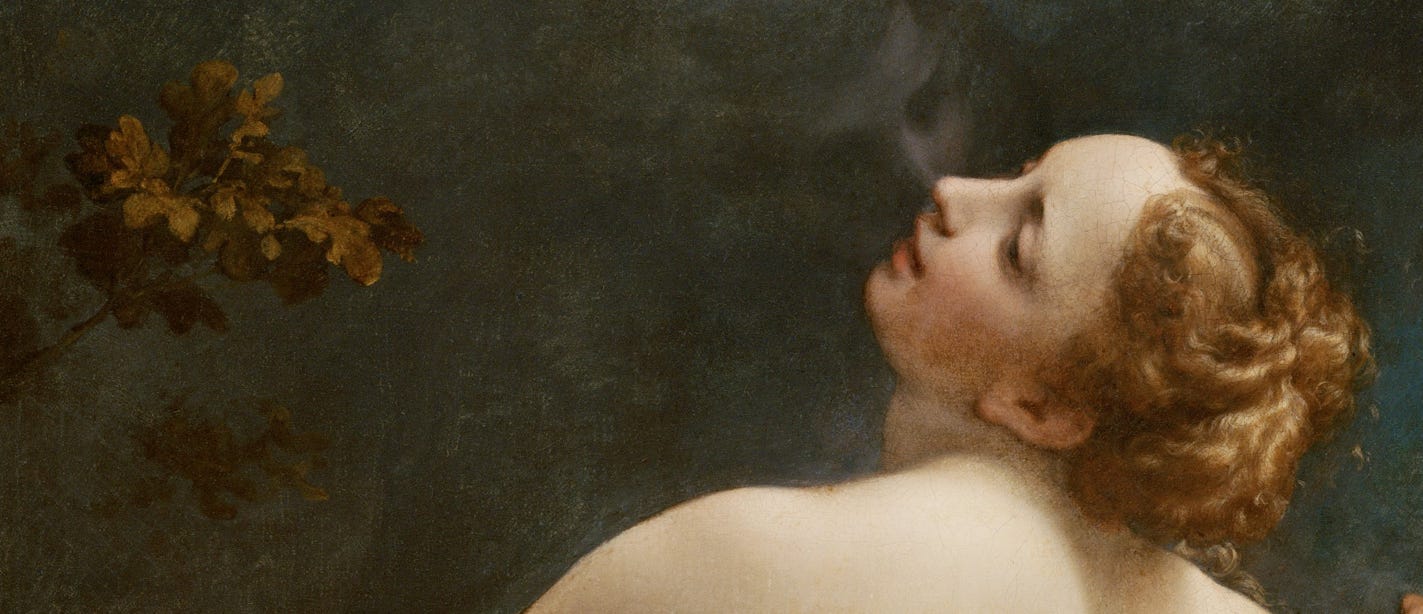
Thus, in his work, you’ll find the fruits of those who worked alongside him — Leonardo’s smoky eyes, Raphael’s mellow harmony, Titian’s luminous colours — and also the seeds that blossomed in painters who followed — Caravaggio’s chiaroscuro, Claude’s idyllic sunscapes, even hints of Watteau’s Rococo revels. His Jupiter and Io, painted in 1530, is the ideal (and most famous) example of Correggio’s style:
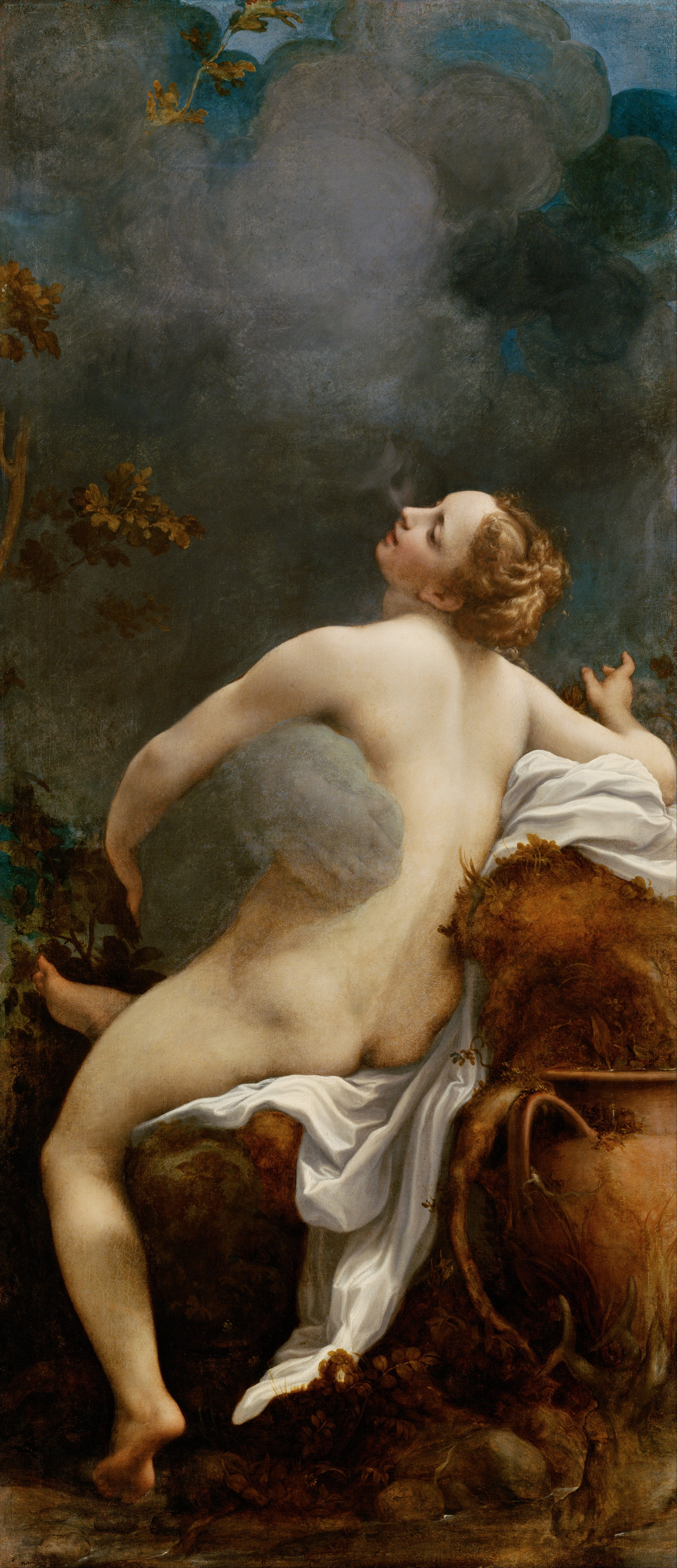
John Ruskin, though he disapproved of what he perceived as Correggio’s irreligiosity and generic classicism, considered him to have been one of the most technically gifted painters in history. In particular, Ruskin praised Correggio for his treatment of foliage, clouds, atmospheric effects, and hair. Notice, in this closeup from Jupiter and Io, the scrupulous realism of the leaves and the impossibly delicate curls of Io’s hair:
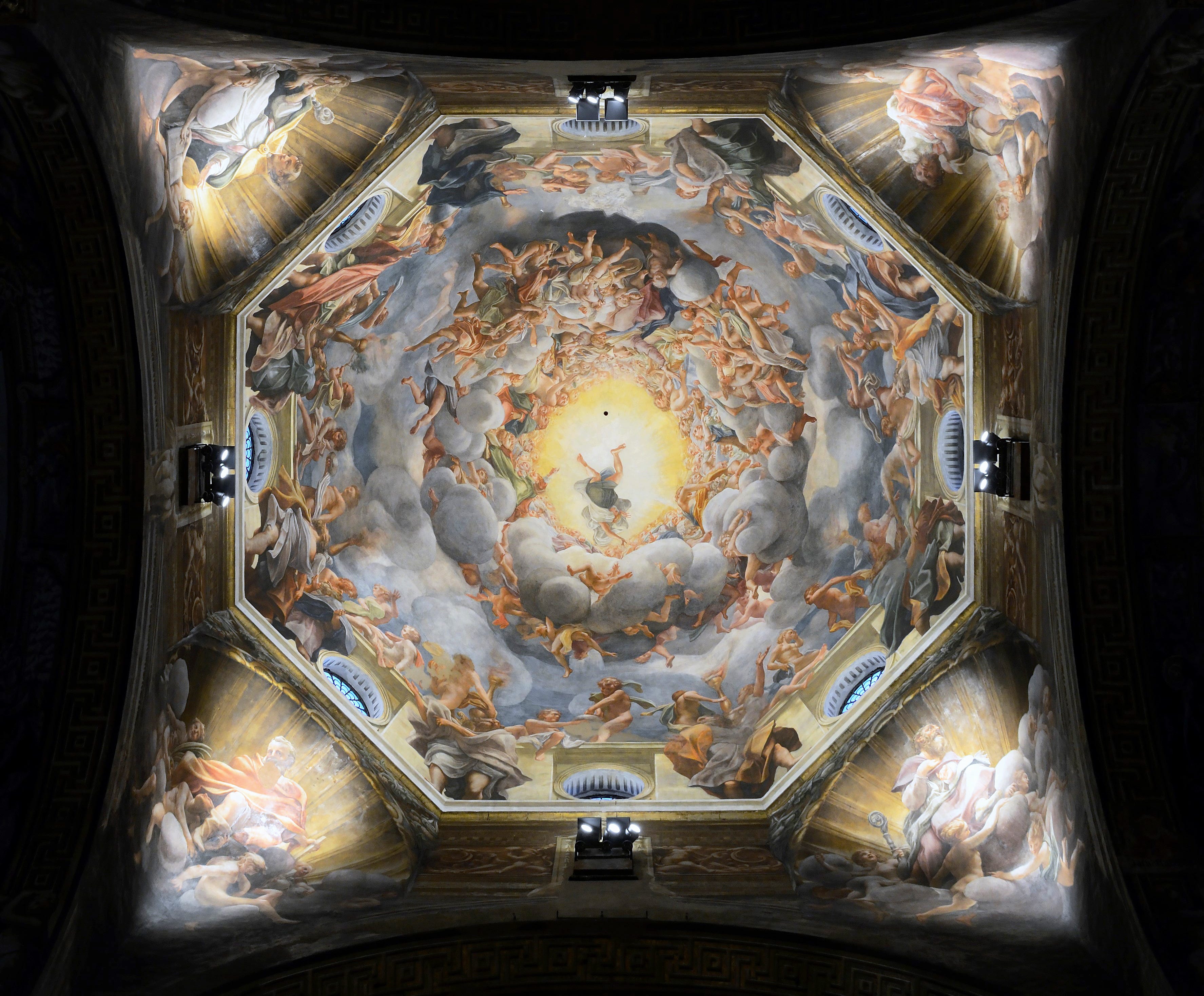
Correggio was also a renowned muralist, and his greatest (or most influential) achievement was to show just how magnificent ceiling paintings, especially those on the inside of a dome, could be. His Assumption of the Virgin at the Cathedral of Parma, painted in the 1520s, was a revelation; it served as a foundation for the next two centuries of illusionistic Baroque murals, whereby two-dimensional surfaces were made to look like the heavens opening up.
These achievements go some way to explaining why, when the National Gallery’s grand staircase was opened in 1887 (as an expansion to the original building of 1838) Correggio was chosen to adorn it. Indeed, one of the National Gallery’s first major purchases was two paintings by Correggio. As the German art historian Gustav Friedrich Waagen wrote in 1854:
…the most important acquisition was made in 1834, by the purchase of the two celebrated works of Correggio, the Ecce Homo, and the Education of Cupid, from the collection of the Marquis of Londonderry, for 11,500l.
Waagen believed it was more expensive than any acquisition in British history. And a few decades later, in 1900, the art historian Selwyn Brinton said this:
In approaching the work of Antonio Allegri, better known as Correggio, we have to deal with an artist who for three centuries now has been at the zenith of his popularity, whose work still remains, and will always remain, of first importance.
How things have changed! But, a little further on in the same book, Brinton says something even more extravagant (and more revealing of the caprices of art history, where reputations rise and fall, almost ruthlessly, on the Wheel of Fortune):
In tracing out that wonderful chain of evolution which the Italian genius created in the art of the Renaissance, as we pause at the very moment of the supremest unfolding of that genius, four names sound into our ears, four personalities stand out before us, most potent in their claim, whether of mystery, of serenity, of strength, of living grace; and those names, those personalities, are Leonardo, Raphael, Michelangelo, and Correggio.
But the supremest genius of four personalities has, in the intervening century, turned to three: Leonardo, Raphael, and Michelangelo are the Trinity of the Renaissance, and Correggio has become a secondary, if not tertiary, figure. It would have surprised Brinton, Waagen, and all the rest to know that Correggio’s popularity has declined, but such is the history of art. That mysterious bust above the National Gallery’s grand staircase is an afterglow of Correggio’s reputational comet, which once burned brightly but has — for now — burned low.
IV - Architecture
The Art of Arrival
Our theme has been faded stars (artists, ideas, or movements, once popular but largely forgotten) and, though there are plenty of specific buildings we might mention, it is a type of building (the decline of which) that I want to investigate: gates.
The word “gate” is multivalent. Hearing it, we might think of a little garden gate, really just a few planks of guilelessly joined wood, creaking on its familiar hinges. Alternatively, and at the opposite end of the spectrum, colossal towers, fortified and crenellated, with battlements and loopholes, are what we imagine. It is this secondary definition that I have in mind. Something like the Westgate in Canterbury:
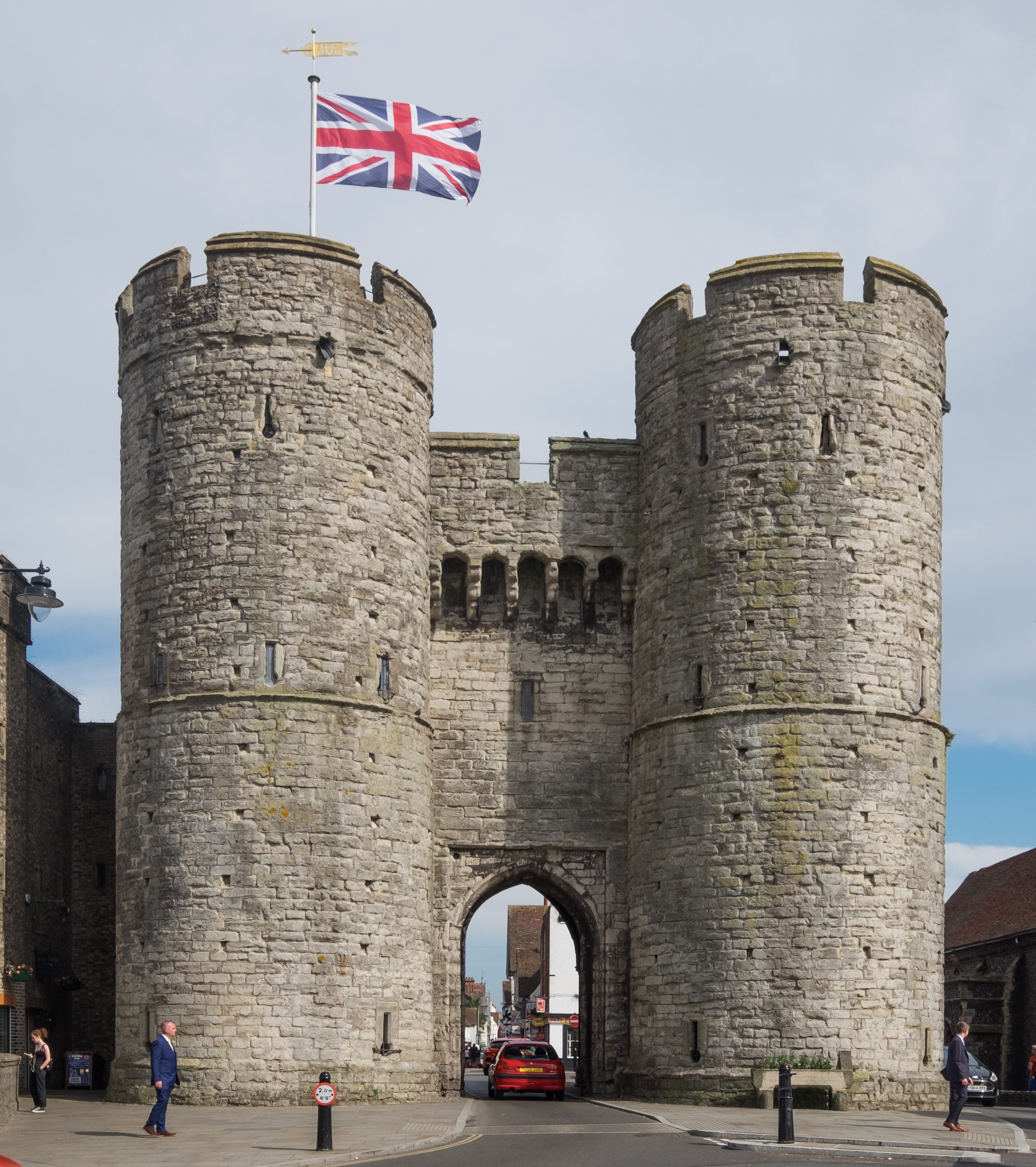
In the past these gates were, if not merely commonplace, universal; once upon a time cities and towns were ringed with defensive walls punctuated by gates that would be closed either at night or in the event of emergency, whether siege, plague, or coup. They (along with town walls) are not something we build any longer, and most of them were demolished in the 19th century, as industrialisation led to the expansion of cities. Walls and gates had become obsolete, and the construction of new roads and houses took precedence over any historical interest. Hence the abundance of street-names like Kingsgate, Bishopsgate, or Eastgate: the last living sign of the structures that once guarded these places. Whatever gatehouses still stand are usually the consequence of a town having avoided industrialisation, or (surprisingly often) because — by virtue of being so strongly fortified — they were ideal prisons.
There is something gorgeously romantic about gates; the mere sight of them as one approaches, knowing that the old core of the city lies beyond, somehow straightens up your back. They are so unlike anything else we build, with their cyclopean proportions and unadorned bulk; a gorgeously robust relic of past ages, reminding us what things used to be like and tethering our modern fancies to local history.
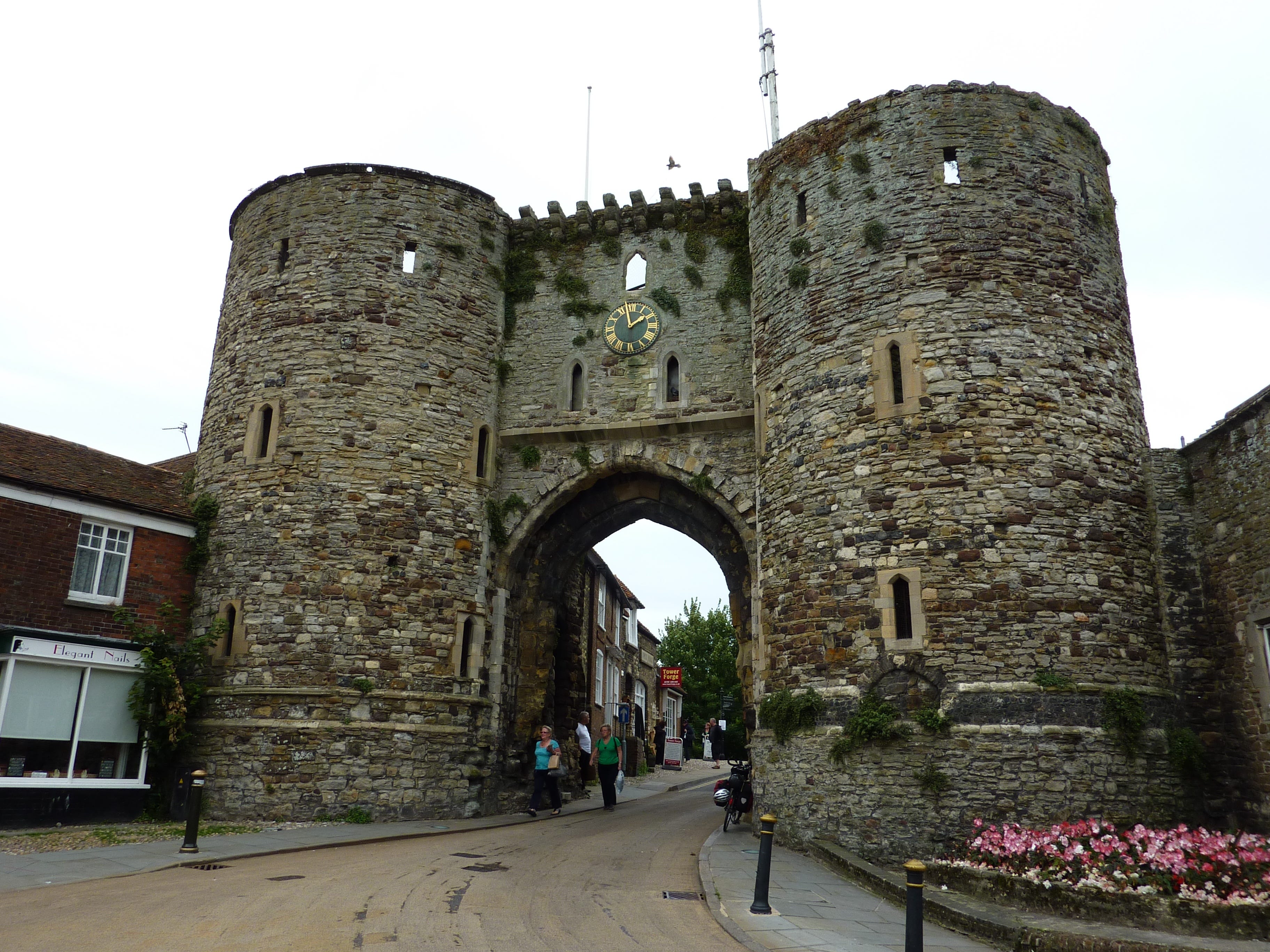
And, alongside these romantic connotations, there’s a very specific form of beauty and utility to gates. See, visiting well-preserved Medieval cities like Canterbury, Rye, and Lincoln, it’s impossible not to be struck by the realisation that one is entering them. We don’t really “enter” cities any more; at some undefinable point fields become outskirts, and outskirts become industrial estates, and an industrial estate turns to suburbs, and suburbs blend imperceptibly with the centre, so that we’ve reached a city’s heart without even realising it. The lack of an entrance or exit prevents you from being able to enter a city, saying as you cross its monumental threshold, “I’ve arrived.” Nor can we quite leave properly, bidding farewell at the gate that marks a city’s edge.
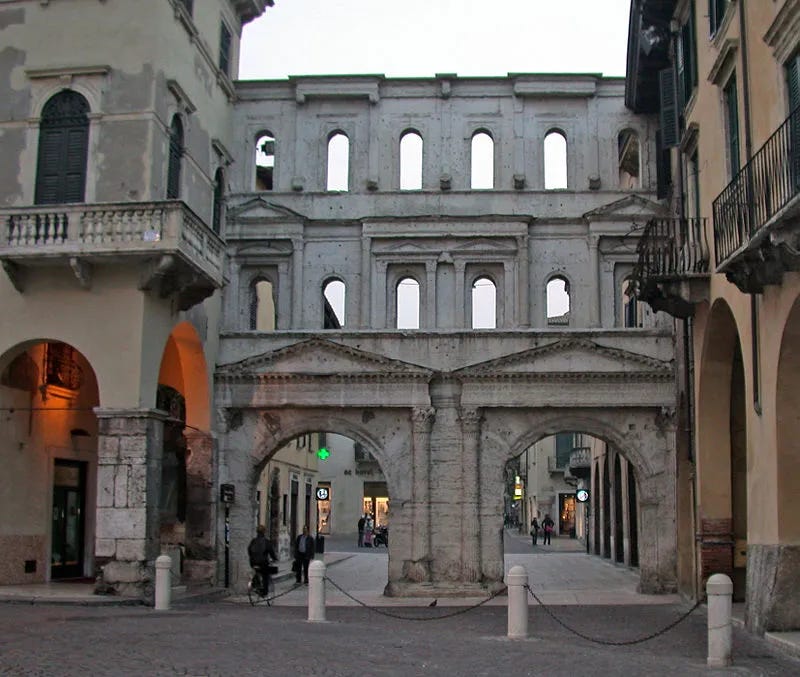
A domestic comparison helps: our homes have doors for security, but they also serve a kind of ceremonial, emotional, and behavioural purpose, dividing one world (the outside) from another (the inside). City gates fulfil the same role, granting to our minds something that, from a biological or psychological perspective, they might actually need. The very entrance to a city can be something we remember and photograph; it can set a tone for what follows, creating an atmosphere of safety and peaceable seclusion, even a sense of belonging, and — simply by creating that division between inside and outside — giving the city a much stronger identity. They are also, in very simple terms, very useful landmarks.
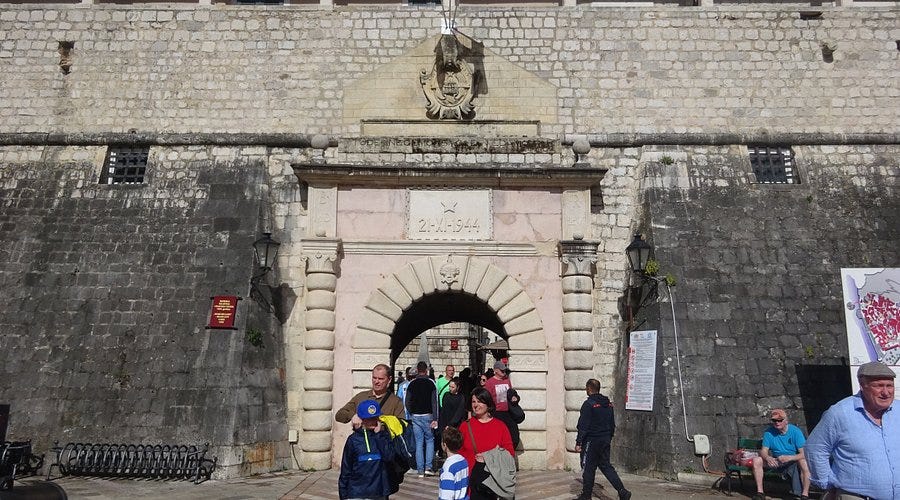
I’m not sure we can justify building more city gates in the twenty-first century; they were, after all, constructed out of necessity during the Middle Ages. Nonetheless, they urge us not to forget a very specific type of urban design that hasn’t received the attention it deserves: the architecture of arriving and leaving.
V - Rhetoric
Homecoming Sickness
Given this week’s theme, it only makes sense that nostalgia should be the subject of our rhetorical studies. After all, nostalgia is among the most effective tools for appealing to, engaging, and even manipulating a crowd. Since time immemorial human beings have suspected that “things used to be better”, and even our present era, whatever you think about it, will eventually be looked back on with nostalgia.
But what does “nostalgia” actually mean? The idea as we think of it now is ancient, of course, but the word itself was only invented in 1688. A Swiss medical student called Johannes Hofer combined nostos, a Greek word that means “homecoming”, with algos, another Greek word meaning “pain”. This was his attempt to classicalise the German word Heimweh, which literally translates to “home pain”. Hofer used it to diagnose Swiss soldiers who’d been fighting abroad and returned psychologically distressed; what he noticed is what we now call PTSD.
Soon enough Hofer’s diagnosis had crossed borders and entered the English language; aboard a ship in 1770, the naturalist Sir Joseph Banks recorded this in his journal:
The greatest part of them were now pretty far gone with the longing for home which the Physicians have gone so far as to esteem a disease under the name of Nostalgia.
So, originally, nostalgia was a medical term; it was regarded as a sickness that (alarmingly) could be fatal. In Robley Dunglinson’s 1856 Dictionary of Medical Science, for example, we find an entry for nostalgia:
An affection produced by the desire of returning to one’s country. It is commonly attended by slow wasting, and sometimes by hectic, which may speedily induce death.
For a long time, even as the word’s purely medical usage started to loosen, it remained an entry in medical dictionaries, albeit with subtly changing emphasis. From Thomas Lathrop Stedman’s A Practical Medical Dictionary, published in 1920:
Homesickness, a longing to return to one’s home or former place of residence.
The phrase “former place of residence”, rather than one’s original homeland, suggests an expansion of Hofer’s original idea, and points toward nostalgia’s entry into the general lexicon. D.H. Lawrence’s Lost Girl, for example, a novel also published in 1920, contains this line:
The terror, the agony, the nostalgia of the heathen past was a constant torture to her mediumistic soul.
Nonetheless, the Oxford English Dictionary of 1933 has it thusly:
A form of melancholia caused by prolonged absence from one’s home or country; severe home-sickness.
And so, even in literature, nostalgia continued to be perceived as a fundamentally harmful and largely medical phenomenon; W. Somerset Maugham wrote in a collection of short stories, in 1936:
Some of the convicts… had such a nostalgia for France that they went mad with melancholy.
In the decades after the Second World War, however, as the field of psychology grew more refined and recognisably modern, nostalgia was freed from its medical genesis and started to attain its more familiar, contemporary meaning. In the 1989 edition of the Oxford English Dictionary, a second definition (alongside the original from the 1933 edition, quoted above) was added:
transf. Regret or sorrowful longing for the conditions of a past age; regretful or wistful memory or recall of an earlier time.
That “transf.” at the beginning of the definition is short for “Transferred”, to indicate that a definition has become non-literal and expanded beyond its original use. As of 2026 the Oxford English Dictionary defines it like this:
Sentimental longing for or regretful memory of a period of the past, esp. one in an individual’s own lifetime; (also) sentimental imagining or evocation of a period of the past.
What was once a diagnosed medical condition of potentially fatal homesickness has become a sentimental longing for or imagining of the past. It turns out the tired one-line joke that “Nostalgia isn’t what it used to be” is, in fact, correct.
VI - Writing
Yours etc.
Whenever I read my emails, I find myself frustrated by the standardised sign-offs, otherwise called valedictions, that conclude them. Like so much else, one is tempted to believe, we used to do it better. I am referring, of course, to the impersonal and generic “Kind regards” or “Best wishes”, sometimes reduced to the casual and laconic “Best”. Are your regards kind? What do you intend to wish me? These are a far cry from the valedictions we find in old letters, as when Sir Francis Bacon wrote to the Duke of Buckingham in the early 17th century, signing off:
Thus may you long live a happy Instrument, for your King and Country, you shall not be a Meteor, or a blasing Star, but stella fixa, happy here, and more happy hereafter. Deus manu sua te ducat, thats the hearty prayer of,
Your most obliged servant,
In the face of our modern, altogether more docile valedictions, and compared with Bacon’s mellifluence, one wonders why we even bother. But (as consolingly as ever!) this problem isn’t new; I found a splendid article in the Los Angeles Times, dated 26th June 1988, saying:
In today’s hurried world of cellular phones, fax transmissions and electronic mail, letter closures and letters themselves may soon be on the endangered species list.
A similar article was published on 22nd July 1999 in The New York Times, when this process of technological development had taken further, more monumental leaps:
Acronyms are particularly popular electronic farewell devices, though senders run the risk of annoying the recipient with sign-offs that take more time to figure out than they would to spell out. Common and not-so-common TLA’s (three-letter acronymns) include BFN (bye for now), TIA (for thanks in advance or that is all), mimicking old public address systems) and FYB (follow your bliss, borrowed from the philosopher Joseph Campbell). Longer alternatives include TTFN, for ta-ta for now, TTYS (talk to you soon), PDAR (please destroy after reading) and C-Ya, for see you. L8R and Latah are commonly used for “later” (variations: E you later and Type at ya later). L2 + P has also been spotted, for live long and prosper. Then there’s g/g, for got to go, and WB (write back) soon.
How modern those acronyms must have seemed, and what a threat to traditional valedictions; how naive and harmless, how full of curious character, they are now! And, reflecting on these articles, it becomes clear that those older valedictions were exactly the same: expressions of their age, rather than of purely personal feeling.
Mary Wollstonecraft Shelley signed off most of her letters with lines like these:
Ever yours truly,
Affectionately yours ever,
Yours affectionately and entirely,
Most affectionately yours,
To sign off with affection seems lovely now (because it’s no longer a typical valediction) but in those days it was standard, and had been for a long time; Sir Edmund Spenser closed a letter to Walter Raleigh in 1589 with the similar:
Yours most humbly affectionate,
And so, a handful of highly personalised valedictions for specific individuals aside (like Thomas Carlyle’s Ewig, meaning “Eternally” in German, to his wife), each era has had its own set of generically accepted sign-offs, and ours is no different. Two hundred years ago no more real affection was necessarily indicated by Mary Shelley’s “affectionately” than kindness shown by our twenty-first century “Kind regards”. Nor are our drab modern sign-offs any less boilerplate than Lord Byron’s rather amusing “Believe me, etc.” (including the etc. every time) with which he signed off so many of his letters, and which was also standard for the era.
Referring to oneself as an “obedient servant” was another popular valediction throughout the 18th, 19th, and 20th centuries. Now, certain official circumstances aside, it would be seen as a peculiar and perhaps sycophantic way to close correspondence, especially an email. In the future our “Kind regards” and “Best wishes” will be similarly quaint, old-fashioned, and inappropriate for correspondence. It’s even possible that, two hundred years from now, somebody will look back on 21st century correspondence and think of our regards and wishes as far more heartfelt and meaningful than whatever valedictions have replaced them.
VII - The Seventh Plinth
Cutting Pages
The paperback version of my book has been released and, though one is supposed to promise what readers can expect, a recent experience reminded me of what readers shouldn’t expect: uncut pages.
For a long time books were printed on folded sheets of paper and bound without those folded sheets being trimmed; it was readers, as a consequence, who had to (using a paper or letter knife) unseal them. We don’t do have to do this any more, but if you buy old books then you will, occasionally, find one that nobody ever cut.
I first encountered this problem, years ago, with Tennyson’s In Memoriam, trying on a train to prize open its sealed pages and believing (briefly) that it must have been a kind of bizarre printing error. It happened again recently, but this time I was well aware that no mistake had been made, and it was simply the case that this particular book’s previous owner had never cut its pages. Alternatively, it’s something you may have seen in historical dramas.
There’s something vaguely sad about finding books that, despite being more than a century old, have never been read. From another point of view, I suppose, it’s quite funny: one can imagine a man with pretensions to erudition whose personal library, it turns out, is actually composed of books with unopened pages! Most of all, though, I found it thrilling to cut each new leaf, realising that this particular page hadn’t seen the light of day since long before cars were invented or even electricity. While the world has been turning and civilisation evolving this page slept, quietly, awaiting its eventual moment of return.
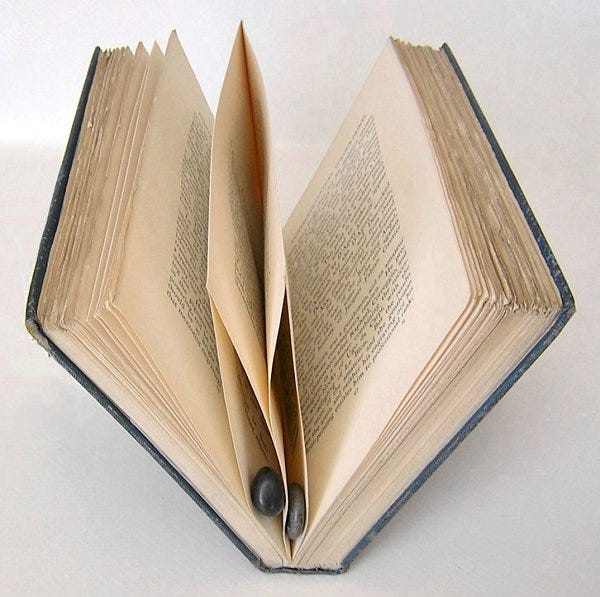
Uncut pages are an inconvenience, but no more of an inconvenience than, say, the fact that in order to see the break of dawn we must either stay up the whole night or rise early. Inconvenience is more or less the only route to a deeper appreciation of things, and the sheer physicality of the book becomes brutally and gorgeously apparent when you have it to cut its pages. These miraculous objects that have lifted humanity from the darkness of ignorance and spread light and life throughout the world and across the ages are, it transpires, nothing more than bundles of mulched and pressed wood (or, once upon a time, rags of cloth), dried and covered in carefully arranged splashes of ink, tied together and glued or sewn into protective bits of board or leather. To realise this, and to interact with a book on those terms, is something I hope every reader gets to experience.
(I should conclude with a word of definitional caution: the terms “uncut” and “unopened” have precise meanings and I may not have used them accurately. This fabulous little article from the Folger Shakespeare Library explains the difference between uncut and unopened.)
And that’s all
We’ve come an awfully long way and we’re not done yet; another Areopagus is glittering on the horizon! But, like all ships, we must drop anchor and rest a while, perhaps even head for port. The Greek poet George Seferis, with the twenty-fourth poem from his Mythistoremia, sings us back to shore:
Here end the works of the sea, the works of love.
Those who will some day live here where we end—
should the blood happen to darken in their memory and overflow—
let them not forget us, the weak souls among the asphodels,
let them turn the heads of the victims towards Erebus:We who had nothing will teach them peace.
Yours etc.,
The Cultural Tutor