

Areopagus Volume CX
Seven short lessons every someday.

Welcome one and all to the hundred-and-tenth volume of the Areopagus. After an especially lengthy instalment last time (which came in at a record 11,000 words) I think a somewhat shorter missive is in order. In which case I will keep my observations concise and tangents leashed; a little poetry to set the tone and we’ll be off. Henry Vaughan, the great Welsh metaphysical and mystical poet, sings us in:
Sound forth, cœlestiall organs, let heaven’s quire
Ravish the dancing orbes, make them mount higher
With nimble capers, & force Atlas tread
Upon his tiptoes, e’re his silver head
Shall kisse his golden curtain. Thou glad Isle,
That swim’st as deepe in joy, as seas, now smile;
Lett not thy weighty glories, this full tide
Of blisse, debase thee; but with a just pride
Swell: swell to such an height, that thou maist vye
With heaven itselfe for stately majesty.
The stage is set, the golden curtain has risen, and the Areopagus begins…
I - Classical Music
Half-Time
Bohuslav Martinů (1924)
Performed by the Brno Philharmonic
The 1924 Summer Olympics Gold Medal Match in Paris, which Martinu likely attended
The World Cup has started; football must be our cue. Classical music and football have a long and delightful history, most famously with the Champions League Anthem (composed by Tony Britten and based directly on Handel’s Zadok the Priest) and with the performance of Nessun Dorma (by The Three Tenors) at four consecutive World Cup Finals, from 1990 until 2002.
Somewhat less well-known is Half-Time, written in 1924 by the Czech composer Bohuslav Martinů. In his case, rather than combining the glamour of modern football with the sophistication of the past, Martinů combined the rising tide of football culture with the equally rising tide of experimental, avant-garde music. He lived in Paris during the 1920s, when Impressionism, Expressionism, Jazz, and Neoclassicism were all reshaping the musical landscape. By the end of the decade Martinů had become a devout Neoclassical composer, but when he composed Half-Time he was in the middle of an evolution. That’s an awful lot of “isms”, but I think it helps to explain Martinů’s peculiar, pulsating music.
His was a style that rejected the emotional preponderance, lavish melodies, and historically-grounded drama of Romantic composers like Richard Wagner or Giacomo Puccini. Instead, Martinů and his contemporaries used brief melodies, intense rhythm, sudden leaps, stretched tonality, and flashes of dissonance, plus inspiration from folk and dance music, all of which combined to create the breathless frenzy that we hear in Half-Time. Frenzied, I say, but also clean, orderly, and clinical. He believed this approach reflected the modern world of machines and motor-cars, of ocean liners and aeroplanes, of glittering steel and smoke-filled cabarets. Lots of noise and movement, but (by virtue of being dominated by machines) there was also precision and calculation. You can hear all of that in Half-Time; football was (as you’ll read below) considered an equally conspicuous aspect of modern life.
Half-Time certainly isn’t, to borrow a phrase and somewhat understate the matter, everybody’s cup of tea. But even for those who cannot quite enjoy the work of composers like Martinů, his work embodies an undeniably intriguing chapter of musical history. If not for the music itself, then at least for what the rise of such music said about the society producing it, I think pieces like these are worth listening to.
II - Historical Figure
Egbert of Liège
Medieval Studies
One thousand years ago, at some point between the years 1010 and 1026, a man called Egbert wrote a textbook for schoolchildren. He was a clergyman and teacher at one of the church schools in Liège, in modern Belgium; during Egbert’s lifetime it was a principality within the Holy Roman Empire and among Europe’s most scholarly cities.
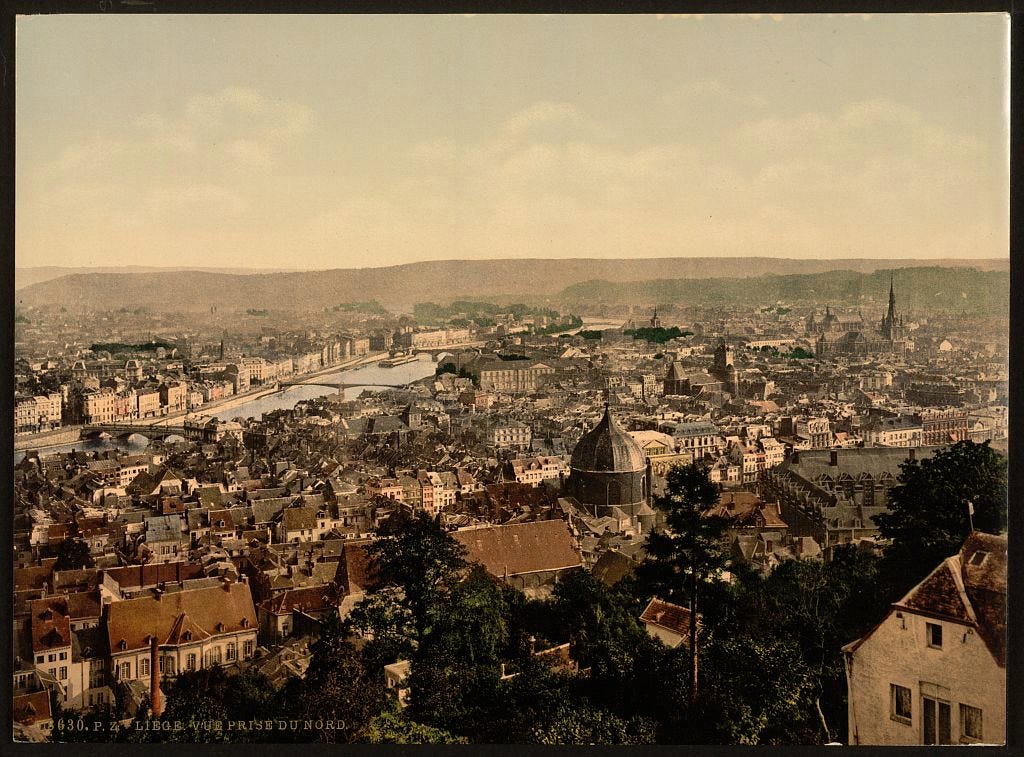
Apart from scanty details imparted in his own work (including a short prefatory letter to the Bishop of Liège) and one mention of his name in a later catalogue, we know no facts of Egbert’s life. What we can say with some certainty, however, is that he was a moderniser; Egbert wasn’t happy with the existing textbooks for novice students (both of which had been around for centuries) and wanted to improve them.
He called his new textbook The Well-Laden Ship and divided it into two parts: The Embellished Prow and The Bronze-Clad Stern. This was an elaborate metaphor with several meanings. The embellishment of the first half, being the front of the ship, was about rhetoric and fine speech; these are the parts of a ship one sees first, and the characteristics we first encounter in a person. Then came the second half, on the subject of religion, which is what (Egbert reasoned) guides humanity; the stern is the place from which a captain guides his ship.
It isn’t anything like a modern textbook, of course, but rather than thinking about whether his method of teaching was better or worse, it’s worth standing back to think of it, above all and most simply, as different. Our teaching methods wouldn’t have been appropriate or particularly useful in early 11th century Liège, and Egbert’s syllabus wouldn’t be appropriate or useful in 2026. Times change, and with them our approach to education must change.
The Well-Laden Ship (which was written in Latin) begins with a long list of single-line proverbs and sayings, most of them folkloric and likely familiar to his young students in their own language. Many are familiar to us; ten centuries later we are still saying:
I’ve never seen a wagon go when placed in front of the oxen.
Or:
When a horse is offered for free, you should not open its mouth.
Or:
An apple turns its stem toward the tree from which it fell.
And:
I would rather be slower to believe things I have heard than things I have seen.
Others are, if not familiar, then wonderfully useful proverbs:
From a shard one can discern what the pot was like.
Or:
Cleverness would be pleasing on this condition: if only person were clever.
And:
It does not benefit you much to eat a lot of honey.
Others are somewhat more obscure, like:
Nobody makes dogs’ hides suitable for storing honey.
But (and a wonderful but we have!) the sole surviving manuscript of Egbert’s Well-Laden Ship is covered with explanatory notes called “glosses”, likely written by one of his students, that provide the proverbs’ meanings. The one just mentioned is explained thus:
No sane person, who wants to have clean honey, pours it into an unclean dog’s hide.
Mixed in with these proverbs are quotes from Classical poets like Ovid, Horace, and Juvenal, lines from the Bible, and grammatical rules or explanations, such as:
Lens, lendis is a little worm; lens, lentis is a lentil.
Or:
Alius means “one of many”; alter means “one of two”.
There is even some geometry:
A compass will form equal circles from a point.
Reading The Well-Laden Ship, and using our imaginations judiciously, we can easily picture Egbert in his classroom reading out a verse to his students and asking them what it means, then helping with the more unusual Latin words until (perhaps because they know the vernacular equivalent) they work it out; we can imagine him asking his students to figure out what a particularly strange metaphor might signify, and asking them if they know who Ulysses or Barabbas was; we can even imagine the schoolboys laughing at one of the funnier or more vulgar sayings.
After the initial run of single-line proverbs, Egbert moves to two-line proverbs, then three-line, four-line, and a final group of miscellaneous length. That rounds out The Embellished Prow, and The Bronze-Clad Stern (which is shorter) contains sections of varying lengths on theology, ecclesiology, Classical history, Biblical history, general Christian wisdom, and a smattering of zoology. He describes the newt like this, more interested in what it represents metaphorically than how it functioned as a creature:
The newt is slow in its step and not steady in its stride. Although he is not agile, he seeks out royal walls. On the other hand, great birds flying through the clear void seek out ponds; and from these they are thrust into hot fires. The vain wisdom of the world yields to the less learned. Although they are slow, they seek after heaven, feeling their way. Those who think they have been quick are tossed farther away.
You can already see that The Bronze-Clad Stern is much more complicated; now his students have progressed through The Embellished Prow, it is time to work them harder. Alongside analysing the Ten Commandments, explaining the importance of Mass, and discussing figures like Moses and Job (all important training for future priests!) Egbert makes some general observations about the present day. There is remarkable realism in The Well-Laden Ship, especially when he warns his students against the excesses of certain priests and condemns the practice of tonsuring. He also offers this familiar lament:
Scholarly effort is in decline everywhere as never before. Indeed, cleverness is shunned at home and abroad. What does reading offer to pupils except tears? It is rare, worthless when it is offered for sale, and devoid of wit.
Egbert’s express purpose was to create a textbook that catered to the needs of his students, and by including so much folklore alongside more squarely religious or historical material, plus a great many strange, fascinating, and vulgar tales, he was calculating on maintaining their interest as they moved toward tackling some of Christianity’s most longstanding and pressing questions. His students surely asked about divine hiddenness, the existence of suffering, the precise details of Lucifer’s fall, or the nature of Heaven and Hell. Egbert had answers:
Hear what “weeping”, what “gnashing” in the world of hell signifies: the weeping arises from the smoke and the heat, and the gnashing of teeth from the icy river of cold. And so they have a double woe, paying for their crime, deservedly.
The Well-Laden Ship is a kind of Medieval primer, introducing new students to all the basics of what they would be learning in a brief, memorable, entertaining, and accessible fashion. They’d finish this foundational course, under Egbert’s tutelage, with a firm grasp of Latin, an introduction to Classical and Patristic writers, some Biblical and Classical history, the rudiments of Christian theology and ecclesiology, a wide knowledge of folkloric wisdom, and a mastery of metaphor (along with some other rhetorical and literary devices). Plus, of course, the proverbs and maxims themselves are useful heuristics for living a decent life. All told, then, this was a carefully worked-out educational programme; not bad for a Medieval textbook!
So The Well-Laden Ship was an ambitious project… and one that never quite achieved what Egbert hoped. His work survives in a single manuscript because, it seems, his reformed textbook was not widely adopted. In which case we are speaking here about an essentially ordinary, if somewhat progressively-minded, man of his times, whose name and work has survived more by circumstance than because of his success and influence. All the better, I say! The great are few and far between; we are, for the most part, wonderfully ordinary. In this way, then, and though it sounds unlikely, an ordinary man like Egbert can teach us more about the Middle Ages than the leading lights of his era.
All quotes are from Robert Gary Babcock’s beautifully accessible and equally scholarly translation (with helpful commentary and an illuminating introduction) published in a lovely little hardback by the Dumbarton Oaks Medieval Library.
III - Art
Dynamism of a Soccer Player
Umberto Boccioni (1913)

This painting is a supreme example of the artistic movement known as Futurism, which was founded in 1909 (with the publication of a “Futurist Manifesto”) and lasted through to the 1930s. It was closely linked to other avant-garde movements like Cubism, Surrealism, and Expressionism, but is distinguished from them partly by the fact that it was a specifically Italian style, and partly by how early it emerged.
Umberto Boccioni, though his life was short (he died during the First World War at the age of thirty-three) had a colossal impact on Italian art; he was among the first true Futurists, and perhaps the first true Futurist painter. What was Futurism? As its name suggests, it was about embracing modernity and casting off the shackles and misconceptions of the past. Italy is filled with essentially endless historical treasures, but in the first decade of the 20th century a group of radical artists started to believe that this immense historical baggage was holding them back. The Futurist Manifesto, written by Filippo Tommaso Marinetti, pulls no punches:
It is from Italy that we launch through the world this violently upsetting incendiary manifesto of ours. With it, today, we establish Futurism, because we want to free this land from its smelly gangrene of professors, archaeologists, ciceroni and antiquarians. For too long has Italy been a dealer in second-hand clothes. We mean to free her from the numberless museums that cover her like so many graveyards.
How to free culture from the past? The Futurists were obsessed with machines, factories, cars, ocean liners, shipyards, trains, and anything else that seemed to be uniquely and fundamentally modern, that seemed to be dragging humanity (even against its will!) into the future. We have a dimmer view of technology now, but in the early 20th century it was a thrilling, fundamentally optimistic frontier.
Just consider the vigour and elation with which Marinetti writes of modernity; his words help us to make sense of Boccioni’s painting, where a footballer has been transformed into a colourful and glittering biological machine, illuminated from all angles by spotlights and trapped in a cycle of perpetual motion.
We will sing of great crowds excited by work, by pleasure, and by riot; we will sing of the multicolored, polyphonic tides of revolution in the modern capitals; we will sing of the vibrant nightly fervor of arsenals and shipyards blazing with violent electric moons; greedy railway stations that devour smoke-plumed serpents; factories hung on clouds by the crooked lines of their smoke; bridges that stride the rivers like giant gymnasts, flashing in the sun with a glitter of knives; adventurous steamers that sniff the horizon; deep-chested locomotives whose wheels paw the tracks like the hooves of enormous steel horses bridled by tubing; and the sleek flight of planes whose propellers chatter in the wind like banners and seem to cheer like an enthusiastic crowd.
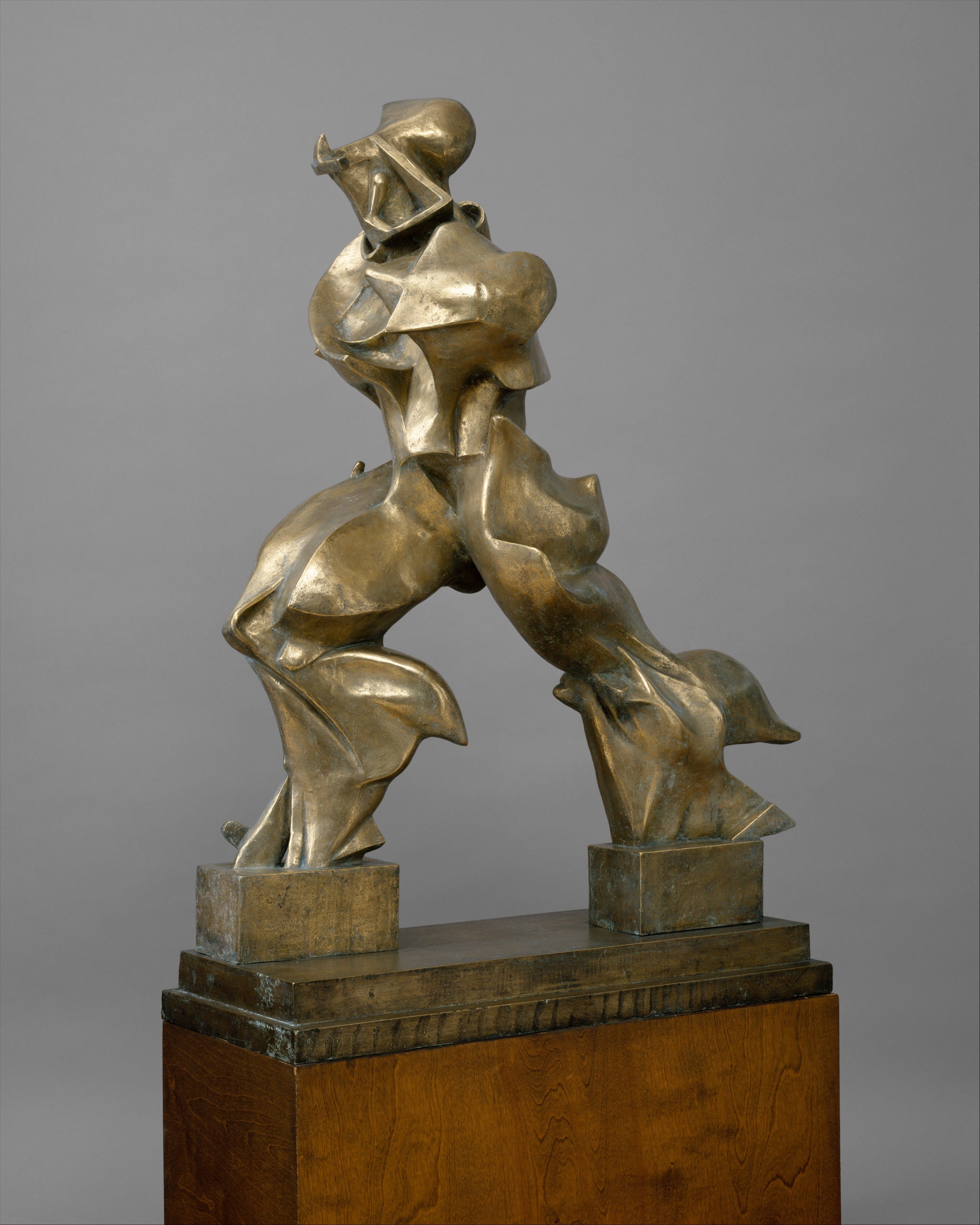
The words and the painting go together. And notice how Boccioni has given his “soccer player” a metallic sheen, as though his body is composed of flowing steel ribbons tracing every moment the player makes during a match. Is it an arm, a shin, a boot? It is all of these things; it is pure movement, pure dynamism.

In this way, Boccioni’s Dynamism of a Soccer Player is like a painted version of his most famous sculpture, called Unique Forms of Continuity in Space and also created in 1913:
But why did Boccioni choose to paint a footballer? Because the Futurists, though it might surprise us, were also obsessed with football. It was invented in the middle of the 19th century and by the First World War had become a global phenomenon, with thousands of workers around the world pouring from their factories into stadiums on a Saturday afternoon. Football (and sport in general) has become an integral part of modern culture, even to the extent that we can’t quite imagine a society without it. But this wasn’t always the case, and perhaps the best way to grasp Boccioni’s reaction to the rise of football is by comparing his painting with a contemporary photograph:
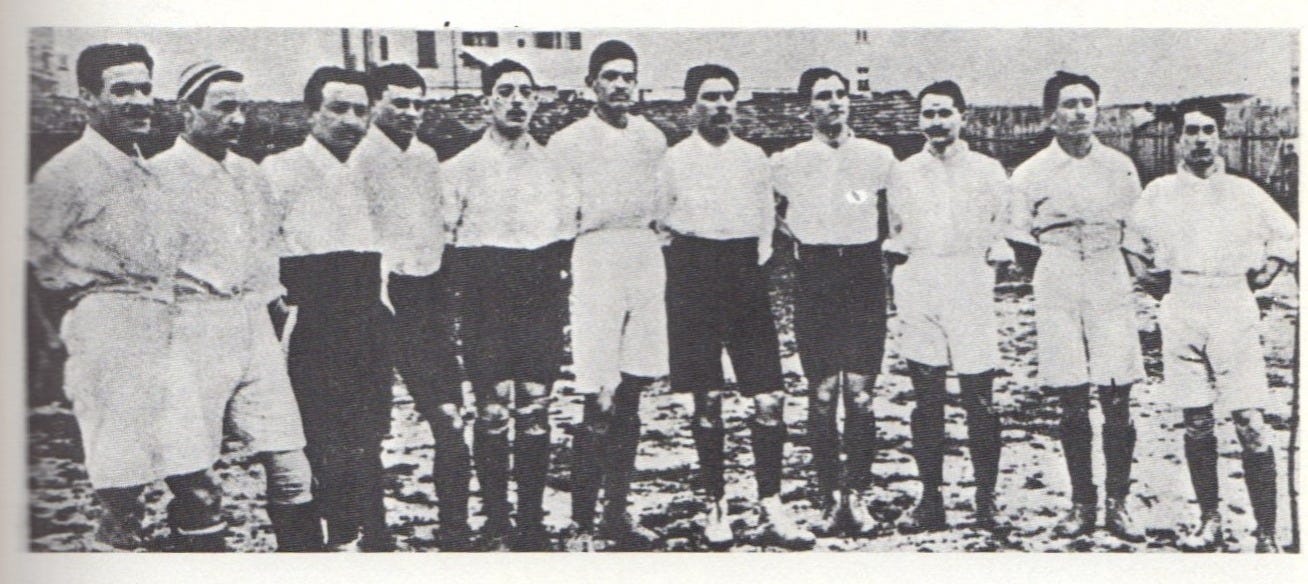
Those footballers in their baggy woollen shirts, high-waisted shorts, and heavy leather boots look incredibly old-fashioned and quaint. We could hardly imagine anything more indicative of a less technologically-advanced era, but in these players (their athleticism, the immense crowds of industrial workers they drew, the new stadiums they were playing in) Boccioni and his Futurist peers sensed a uniquely modern phenomenon. How things look and how they feel are different; a painting, even it doesn’t “look” like reality, is a valuable historical document and insight into how people thought about the world. And so, in some sense, a painting like Boccioni’s is more accurate, or at least more revealing, than a photograph.
IV - Architecture
Defaultism
I often find myself in rooms that look like this:

These spaces seem to fill our modern apartment blocks, schools, universities, offices, co-working spaces, museums, airports, and libraries. Even when buildings didn’t used to have this appearance, they have frequently been “renovated” into it. Grey carpets, pure white walls, stark white lighting, no cornices or ceiling roses or door mouldings, white ceiling tiles (or a plain white ceiling), brushed steel railings and doorhandles, and generic, standard-issue furniture. The consequence is a cold, industrial aesthetic; these places feel more like prisons than public or domestic buildings.

It’s sort of like being inside a three-dimensional spreadsheet, and I don’t think it’s very good for our humanity. After all, nothing could be further from the detail, colour, texture, and variation of the natural world. And that explains, perhaps, why we generally prefer buildings and interiors that emulate the qualities of nature. The question isn’t what “style” we prefer, but what human beings are biologically, psychologically, and socially suited to.

Nonetheless, I think this phenomenon should be named, because when things have names they are much easier to talk about. It might not be a self-conscious style in the same way that Art Nouveau or Art Deco were, but it is a style nonetheless, a kind of contemporary vernacular that has emerged as a result of various social, economic, legal, and cultural forces. Its qualities are, in no particular order:
Greyscale colours
Harsh lighting
Absence of decoration
Brushed steel fixtures and fittings
Standard-issue furniture
Synthetic materials
An atmosphere of sterility
This co-working space below (the image is taken from their website) is a good example, with ominous squares of white light glowing overhead and the only warmth coming from the wooden legs of the armchairs; otherwise it is a blank, greyscale box. As ever, there are several reasons for the rise of this style, but I’ll reserve that for a future Areopagus; for now I want to focus on identifying it.

Does anybody actually like this sort of thing? I struggle to believe it. True Minimalism can be beautiful, but this is not Minimalism (or even Functionalism!) as conceived by designers like Adolf Loos, Ludwig Mies van der Rohe, or Le Corbusier. And (as mentioned above) this doesn’t only apply to new buildings; I have experienced first-hand a strange determination to “refurbish” or “renovate”, especially and including things that obviously did not need to be refurbished or renovated. It is genuinely and unfixably heart-breaking to see old rooms that have faithfully done their duty for decades gutted and resurrected as pale, ghostly versions of their former selves.
Of course, the desire to renovate is nothing new. Our ancestors were far less cautious when it came to rebuilding or altering major historic buildings, for example. Just look at what the Victorians did to St Alban’s Cathedral!
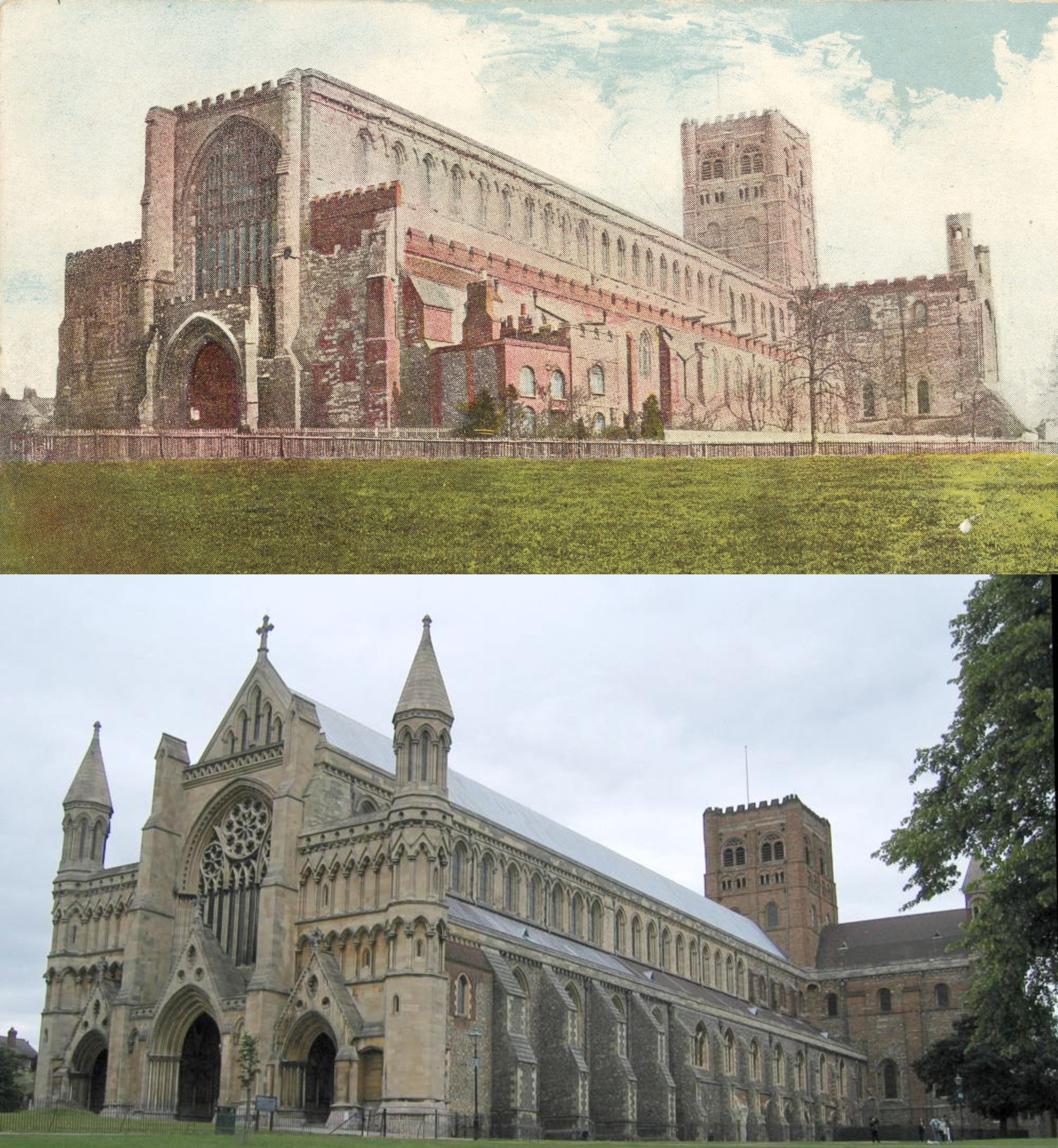
Nonetheless, those Victorian restorations were at least attempts to create something sympathetic to and authentically grounded in what was being refurbished; we have the opposite approach. And so, whereas we once didn’t have the resources to constantly refurbish everything, and at least believed that if something had worked for a long time then it didn’t need changing, we now have the resources (plus a strong economic incentive) to refurbish everything we can get our hands on, combined with a general aesthetic preference for the sterility of white walls and grey carpets.
So: I have decided to call this style (for now at least) Defaultism. If one were to imagine a default room, devoid of everything that could give it any personality because it is waiting to be given one, then I think we would imagine something like this:

Each and every element is the most basic and uninteresting version of what it could be; the materials and furniture have been chosen not because of their beauty or even usefulness, but because they are the cheapest and (therefore) default option. It all feels so strangely careless.
All that remains to be asked, and most importantly, is: what do you think? Some have said that Cheapism, Absentism, or even Corporate Liminalism would be better names for this generic modern style of ours. Other suggestions are Consumerist Vernacular, Miserlyism, Genericism, and Crapism. Do you like any of these? What would you call it? Email me with what you think is the right name for this style (or, of course, with a rejection of my thesis!) and I’ll share your responses in the next Areopagus.
V - Rhetoric
“He’s got the bit between his teeth… alright.”
Sometimes, Robert Bolt teaches us, the best thing we can do is repeat ourselves. See, a few weeks ago I went to watch Lawrence of Arabia at the Prince Charles Cinema in London. The place was sold out and, I suppose, my experience wasn’t totally dissimilar to what opening night must have been like in 1962. Even in our world of Artificial Intelligence, real film projection is something that literally cannot be replicated by digital technologies, because the nature of the light entering our eyes is different. We can replicate the grain of film projection, but we cannot replicate its actual colour, texture, and vividity; the only way to see it is by looping reels of physical film into a sprocket and shining a light through them.
In any case, Robert Bolt (known for writing Doctor Zhivago and A Man for All Seasons) wrote the screenplay for Lawrence of Arabia, and what a screenplay! There’s a great deal we could say, but I want to focus on a specific (and common) technique that Bolt uses uncommonly well: repetition.
The film is punctuated by certain lines that reoccur, in each case under changed circumstances; I have chosen four examples. There are spoilers ahead, and this section will make more sense if you have seen the film; for those who haven’t, but wish to read anyway, I have tried to make it comprehensible.
An Extraordinary Man
The film begins with Lawrence’s funeral at St Paul’s Cathedral; on the steps, after the ceremony, a reporter asks Colonel Brighton what Lawrence was like. Brighton says, “He was the most extraordinary man I ever knew.” The audience, at this point, naturally thinks that Brighton means this as a good thing, that he must be looking back on a man who was heroic, brave, gifted, and morally upstanding. This was the general public’s view of Lawrence, and the reporter seems happy with his quote; but we notice a strange ambivalence in Brighton’s expression and tone of voice. We come away feeling slightly uneasy about his remark.
Much later in the film (which takes place nearly two decades before the funeral), when Lawrence has already whipped up a revolution, stormed Aqaba, and created a situation that he cannot quite control, turning himself into a kind of warlord and losing his own identity amidst the glory and brutality of war, we hear the same line. Lawrence is back in Cairo, where General Allenby is trying to convince him to return to Arabia; Allenby says, “You are the most extraordinary man I ever met.” And now we understand what Brighton first meant by extraordinary, with all the contradiction and ambivalence that word really contains.
Appraising the Situation
In Cairo, before Lawrence has been sent to Arabia, Mr Dryden — a sort of politician and spymaster — tells him that his mission will be to, “Appraise the situation.” This is already rather funny, and the audience laughed a lot; it’s the typically euphemistic language of espionage, perhaps with a dash of characteristic British understatement. We know that “appraising the situation” will mean something rather more complicated, possibly even more conniving, than the tawdry words suggest.
The audience laughed when Dryden said it, and they laughed even more when Lawrence himself says the same thing in the middle of the desert. He has joined up with Colonel Brighton, who asks Lawrence why he was sent; Lawrence replies, not without a wry smile, “To appreciate the situation.” But Bolt’s humour is never farce; we suddenly realise the true scale and strangeness of the situation, and the immense gulf that always exists between theory and practice. Plans are easy to make in an office, much harder to implement in the field.
(Why does Lawrence say appreciate rather than appraise? I can’t believe this was an oversight by Robert Bolt in an otherwise watertight script; it speaks, I think, to Lawrence’s dislike for authority and general eccentricity.)
Silly, barbarous, and cruel
Lawrence, newly arrived in Arabia, is led through the desert by a guide. They reach a well and they drink. A man approaches from the distance and shoots Lawrence’s guide; Lawrence tells this man, Sherif Ali, that such behaviour is the reason why Arabia has been ruled by the Ottomans for so long, and that without change they’ll never be able to win freedom. He calls Ali and his people “silly, barbarous, and cruel.” At this point Lawrence seems to have something of the moral high ground, given that he’s just seen an innocent man shot dead.
Later on, Lawrence arrives at the camp of Prince Faisal and gives him strategic advice, winning Faisal’s approval with his boldness and his detailed knowledge of the Quran. But when the prince keeps Lawrence back to speak with him privately, Faisal asks Lawrence why he is trying to help people who are “silly, barbarous, and cruel”; Sherif Ali reported to Faisal what Lawrence said at the well.
Now the situation has reversed and it is Lawrence who occupies the moral low ground, who appears to be something of a hypocrite and a schemer, much like his mentor Dryden. It is a reputational wound that, though Lawrence more than overcomes it in the short term, never quite heals. Who’s team is he really on? As the audience we instinctively side with Lawrence, but Faisal’s words make us question our allegiance to the film’s protagonist.
The bit between his teeth
Towards the end of the film, after Lawrence has returned to Arabia and (filled with a new, messiah-like confidence) leads the revolutionary forces toward Damascus, Brighton reports to General Allenby on the situation, saying of Lawrence, “He’s got the bit between his teeth, alright.” It’s a very funny thing to say, and another wonderful example of British understatement; the audience laughed.
Allenby asks Brighton what he means, “Cocky?” And after a pause Brighton says, “He’s really got the bit between his teeth… alright”. It’s funny to hear him say it again (the cinema erupted into laughter) but Brighton’s inability to explain Lawrence’s changed behaviour as anything other than “having the bit between his teeth” is almost apocalyptic. If Brighton simply cannot bring himself to describe what’s happened to Lawrence, then it must be something very strange and unnerving that has taken place.
It is a genuinely spine-chilling moment, perhaps the darkest moment in the whole film, and yet it was crafted with immense subtlety. Brighton could have said something superficially shocking or gruesome, but by repeating himself he conjures a much more disturbing trepidation.
***
In all four examples the use of repetition is both very funny and very meaningful; tragedy and comedy are united, and one can interpret the words in manifold ways. It sounds counter-intuitive, but Bolt created more meaning by repeating words rather than adding new ones. This has the secondary effect of engaging the audience; we are required to notice that something has been repeated, and so the potentially deeper meanings are there for us to discover, as we reflect on them, instead of being spoon-fed every little detail, which would make for a dull and tiring screenplay. Sometimes, Robert Bolt teaches us, the best thing we can do is repeat ourselves.
VI - Writing
Dramatis Personae
How to find a style? It’s what every writer needs and dreams of. A story about Robert Browning (1812-1889) is instructive, and will (I trust and hope) provide a memorable way of answering that interminable question.
Where to begin? With the fact that Browning, though very obviously a talented writer, struggled at first to find a way of writing that worked. He was good at and enjoyed crafting personalities; he could somehow inhabit a person’s moods and motivations, as if by magic, and lay out their internal state of mind. But he wasn’t good at constructing linear narratives; he couldn’t write a decent plot.
That meant plays weren’t the right medium, and it also ruled out novels. They are written in prose, anyway, which was too restrictive for Browning, who preferred to range widely and speak from the soul. It would be another seventy years before novels reached an experimental stage (with the rise of stream-of-consciousness writing) that might have suited Browning’s inclinations. No plays or novels; that left poetry.
But Browning struggled to be sufficiently “objective” when he tried to write them. He couldn’t narrate a series of events like (for example) Byron had done in Don Juan or Tennyson in his Idylls of the King. Nor could he adopt his own, autobiographical point of view, as Wordsworth had. The approach of John Keats, who crafted a kind of ethereal poetic personality to muse on the nature of the world, was too delicate and composed for Browning’s more vigorous, almost volcanic manner of expression.
The soliloquys of Shakespeare, where individual characters pour out their thoughts and feelings, trying to figure themselves out in real time, was a model for emulation. But Browning still struggled with the restrictions of existing poetic and dramatic forms; they inevitably forced him to write in a way that held back his energy, or required him to provide additional information of the sort he simply wasn’t interested in. Finally he stumbled on the idea of leaning into, rather than fighting, his inclinations. He wouldn’t try to be objective, to narrate a series of events like a story-teller with all the facts to hand; nor would he try to remould traditional poetic forms around his natural way of expressing things.
How? Browning would take a soliloquy and make that the entire poem! He decided that every word we read would come from the perspective a specific individual, without the context of additional speaking characters (except as reported speech) and without objective narration. All the information we learn about a person, or a series of events they’re involved, will be revealed to us by their musings and recollections.
Thus Browning found his form — the ‘dramatic monologue’ — and with it crafted some of the most gorgeous, moving, troubling, and labyrinthine poetry in the English language. It also brought him fame, success, and influence. There are plenty of exceptions to (better described, I suppose, as iterations on) this model, but it was the foundation for his work. With it Browning created a pantheon of living characters hardly less multitudinous than Shakespeare’s, most of them strange, eccentric, disturbed, and extraordinary. One of his collections was called Dramatis Personae, typically the name for the list of characters in a play. It acknowledged what his poetic output had become: a colossal catalogue of personalities.
The concept of a dramatic monologue is obvious in retrospect; the same is true of all artistic innovations. A thing, once invented, is easy to imagine; when something has yet to be invented you cannot simply conceive of it, but must work slowly and often erratically toward its creation. This is what Browning did, and by finding the right medium he also find his “style”; once he realised that his medium was the internal expression of a personality, the question of how to express that was much more straightforward.
What does Browning’s story teach us? That our style is what we write about, not how; the how is a result, the outward appearance, of the what. And by “about” I don’t mean in the general sense of broad topics like paintings or sport, but in the highly specific sense of which few details, among the infinitude that could be chosen, you select. We must pick our medium — our framing, if you like — and know that what is colloquially referred to as a “style” will emerge naturally from that choice; our aim must be to find our own Dramatis Personae, and all the rest will follow.
VII - The Seventh Plinth
Scottian Consolation
I’m always talking about the decline of taste. I see how new things are made, how old buildings are refurbished, and it breaks my heart to witness a deluge of tastelessness smothering the Earth. Hence the section, in this Areopagus, on Defaultism.
What consolation can there be? Sir George Gilbert Scott (famous for restoring Britain’s Medieval cathedrals and churches, and also for designing St Pancras Station and the Foreign Office Building) is a surprising source of it. Consider what he wrote in the year 1858, in a little-read book (who ever knew that Scott wrote anything?) called Remarks on Secular and Domestic Architecture:
Nothing, indeed, can be more humbling than to examine into the multiplied proofs of the fact, that during the last five centuries, in which we consider ourselves to have been gradually progressing in civilization, there has been an equally progressive deterioration in taste
The same decline of taste he was writing about has become the very thing I now dread to see destroyed! Further:
Surely nothing was ever half so villainous as the villa-building about London !
If Londoners are so idiotic as to pay such rents, we can hardly expect landlords to deal more liberally. The cupidity of the landlord goes hand in hand with the stupidity of the tenant ; and the consequence is, that the beautiful fields round London are every day being rendered hideous and disgusting by speculating builders, to whose remorseless hands they are consigned…
Even near country railway-stations the same miserable policy prevails, and we see at Harrow, Malden, Kingston, and round the Crystal Palace, outlying masses of the same hideous and close-packed house-building which disgraces the outskirts of London.
Those hideous and close-packed buildings Scott laments as tasteless, soulless, ugly modern architecture are the same hideous and close-packed buildings that tourists travel from around the world to see, that people dream of living in, that I admire each and every day. I don’t mean to say that certain problems with modern design aren’t real; they are. But Scott’s condemnation of architecture in his own time, a century and a half ago, reads as more or less identical to contemporary condemnations of twenty-first century architecture. Scott thought it was ugly; we love it. Will future generations feel the same about what we are currently building? It’s hard to believe, but history tells us that, when enough time has passed, they probably will.
And that’s all
We close with the opening stanza of Pablo Neruda’s rightly legendary Sonnet XVII, translated by Mark Eisner. There has been a great deal of information, of context and name and place, throughout this Areopagus (as throughout them all); time to move beyond the deceptive world of supposed fact and search for a more universal, unnameable form of truth.
I don’t love you as if you were a rose of salt, topaz,
or arrow of carnations that propagate fire:
I love you as one loves certain obscure things,
secretly, between the shadow and the soul.
Is there something you love, obscure and hidden, between the shadow and the soul? I hope so. Until next time, Beloved Readers; I bid you farewell!
Yours,
The Cultural Tutor