

Areopagus Volume CIX
Seven short lessons every someday.

Welcome one and all to the hundred-and-ninth volume of the Areopagus. Long time, somewhat little see. I have been quiet of late: so, before we return to our seven short(ish) lessons, here’s why.
I want to make a TV show about architecture. Last October I uploaded a pilot episode to YouTube and it went better than I could’ve hoped: 5.4 million views, 378k likes, 23k comments, and 241k subscribers on a brand-new channel. People want more, so now it’s time to make the full thing.
The concept is simple: do for buildings what Planet Earth did for nature.
Why does this matter? First, because we’re surrounded by buildings, and so this is something that’s genuinely universal. Second, because there’s a global feeling of dissatisfaction with ‘modern architecture’ and — though it gets written about online all the time — nobody’s really given a voice to that feeling on film or TV. That’s what this show will be. But we’re not just criticising modernity (that’s easy): the point is to learn from the past in order to improve the present… for everybody! Third, because there’s a drought of high-quality culture shows. This needs to change; the world is crying out (more than ever) for better documentaries about the arts.
So that’s what I’ve been doing these last few months: researching and writing scripts for six full-length episodes. They’re ready, and production will begin on the show as soon as we’ve raised the funding. You’ll find more information about the project on this website.
In which case, I suppose, there’s something of a call to action here. Here’s the post announcing our intention to make the show. Any likes, or especially comments, will help prove that there is interest in a show like this. And, if you happened to work in the industry or know anybody who does, now is the time to reveal yourselves.
To all who are or have been paid subscribers to the Areopagus, this is the work you’ve been supporting of late. Without it, I wouldn’t have been able to dedicate so much time and effort to researching and writing these scripts. A sign of my gratitude will be forthcoming in due course. I’ll say more when there’s more to say.
Finally: a reminder that my travel show with Audible is out now (listen here) and that my book remains for sale in some parts of the world. When it’s finally available in the United States I’ll be sure to let you know.
And now, with all that caveating complete, it’s time to begin. What lies ahead? Medieval encyclopaedias, 1920s newsletter, an exploration of how Homer’s Odyssey has been interpreted down the millennia (including the controversial 19th century theory that it was written by a woman), an alternative way of thinking about Gothic Architecture, Charlie Chaplin as a guide to understanding the Renaissance, and more.
Avanti! Forza! Andiamo!
I - Classical Music
Summer Music
Arnold Bax (1915)
Performed by the London Symphony Orchestra
Golden Summer, Eaglemont by Arthur Streeton (1889)
Now that Summer is on the horizon — and, this week in England, appears to have arrived all at once! — it seems right that music not only inspired by Summer, but written with the full intention of making us feel it, should be our starting point.
This is a tone poem, a single-movement work of orchestral music intended to evoke a specified place, poem, person, idea, or theme. In other words, this music is definitively about something. And, even without this particular piece’s title — Summer Music — I think we might have guessed its subject: the fluttering woodwinds, shimmering strings, and pastoral horns seem to blow over us like a warm breeze.
But tone poems have featured more prominently than perhaps any other musical form in the Areopagus. In which case I will keep this week’s musical segment brief (rather than repeating what I have said before about tone poems) and stick to a few lines about the composer, who deserves pause for thought.
Sir Arnold Bax is a name known to devoted fans of classical music; for others it will be unfamiliar. That is because he has, so to speak, gone out of fashion. Why? I think it has something to do with prejudices about the artists of his generation (Bax was born in 1883 and lived through to 1953) who did not entirely embrace modernism and stuck to more traditional forms. This seems unfair. For although he served as Master of the King’s Music, loved cricket, and wrote a score for the 1948 film version of Oliver Twist, Bax cannot be reduced to a “stick in the mud” stereotype.
He was, rather, both a remarkably passionate and vividly imaginative man: alongside his music Bax wrote four plays, thirty short stories, and over three hundred poems under the pseudonym Dermot O’Byrne. These lines come from a 1909 poem called Green Magic, about a woman who has fallen in love with the sea. It exemplifies Bax’s combination of startlingly intense passion and relatively boilerplate sentimentality:
Give me the twilight and the stillness; fade,
O formless wizarderies, thou chill soft fire,
Thou pitiless desire!
Yes, even across this page whereon I write
Falls the green shaken light
Out of thy luminous heart, a blinding might.
Between the sighings of the falling towers
Within the firelight world I hear the showers
Of blown spray flung
On dazzled shores, and savage chantings sung
Through the grey corridors of the house of winds,
The insidious voice singing that calls and binds.
I am thy slave, mine all is vowed to thee,
Whilst over me thy love and anger roll,
And croonings of thy passionate icy soul,
With whispering waves peopling eternity.
O love! O sea!
At his worst Bax has been accused of living through a sort of prolonged artistic adolescence, unable to fight past the sheltered sentimentality that prevents art — whether poetry or music — from becoming truly great. But, even if that accusation is reasonable, I am not sure Bax ever pretended to be anything else! So let us enjoy him for what he was, without worrying about where he “ranks”, rather than for what he might have been. His Summer Music brings us Summer; for what more can we ask, as the hot months of 2026 (for those living in the northern hemisphere) unfurls its wings of glittering blue?
II - Historical Figure
Shihab al-Din al-Nuwayri
A Fountain of Delight
What was the past like? A question that never ceases to delight. Partly because of the inherent joy in discovering what strange or eerily familiar things our ancestors used to say and do; partly because, by learning about them, we are always and inevitably learning about ourselves. Only by holding up a mirror to previous ages does the twenty-first century really make any sense.
One of the best ways to answer that question is looking at historical encyclopaedias. These were (and remain, of course) collections of any society’s extant knowledge; to read them is to enter the past. One such example is the fabulously titled The Ultimate Ambition in the Arts of Erudition, compiled by an Egyptian bureaucrat and scholar called Shihab al-Nuwayri in the early 14th century. All quotes included below come from Elias Muhanna’s elegantly annotated and gloriously readable 2016 translation, which I heartily recommend for anybody inclined to delve further.
So: al-Nuwayri was born in the year 1279 and after a distinguished bureaucratic career retired to Cairo, home of the Mamluk Sultanate that then ruled Egypt (and much further afield), and the cultural and literary capital of the Islamic world. There, alongside working as a copyist, he compiled The Ultimate Ambition in the Art of Erudition, drawing both on his own vast experience and the fruits of Cairo’s many academies. It was finished in 1329, four years before al-Nuwayri’s death in 1333.
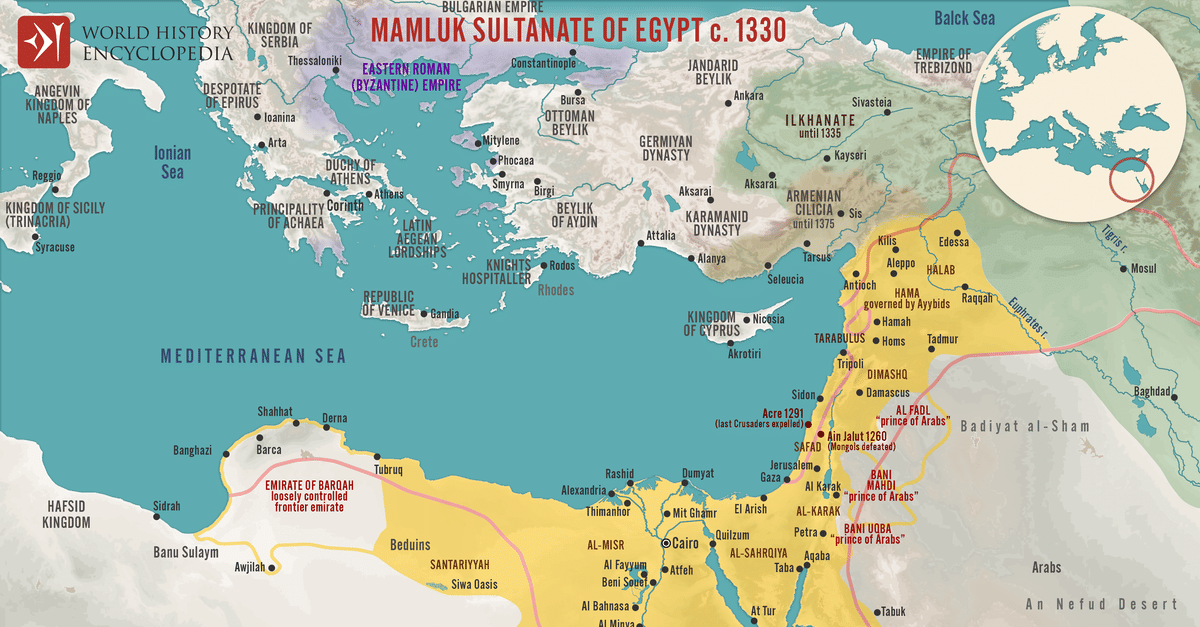
He divided his encyclopaedia into five books (The Universe, The Human Being, The Animal Kingdom, The Plant Kingdom, and History) and these were further divided into five sections, with each section containing dozens or hundreds of chapters. It runs to over two million words in total, which is about four times the length of War and Peace.
What is included in The Ultimate Ambition in the Arts of Erudition? Astronomy, the origins of rain, Quranic exegesis, rhetoric, verse, an exhaustive account of recorded history (all the way down to and including al-Nuwayri’s present day), zoology, botany, minerology, guidance for scribes and accountants, draft contracts for rental agreements or marriages, proverbs, medical advice, recipes, metaphysics, theology, inquiries into the nature of happiness, explanations of how to make apologies, first-hand accounts of major battles, and reports of his own dreams. That sounds like a lot, but even this wildly varied list is little more than a glance at its contents.
Where to begin with a work so vast in scope and approach? Al-Nuwayri’s own prologue should suffice: it sets out the scale of his ambition and also introduces something of his style. For al-Nuwayri there was no difference between science and poetry, between the work of a meteorologist and that of a clerk. All would benefit from this grand work:
Among the worthiest things to adorn the pages of books and to be uttered by the tongues of pens from the mouths of inkstands is the art of literature. The sharp-witted produce it and the highborn claim descent from it. The scribe makes it the means by which he achieves his ends and the path that never leads him astray. When he encamps in its valley, his deserts become cultivated, and when he visits its watering places, he deems them to be sweet. He descends into its courtyard and finds it ample and spacious, and ponders its quandaries only to have their explanations made clear.
And, for a further taste of al-Nuwayri’s range — which, surprising for modern readers, goes far beyond the religious or cultural limits we might assume to exist in 14th century Cairo; many of his passages were even (I felt) too prurient to publish here! — consider his introduction to the book on humanity:
This book contains poetic motifs that are pleasing to the listener, delightful to the ears, adorning the pages like gems… It encompasses fine similes and sublime love poems; holy lineages and famous battles; ancient proverbs whose origins are elucidated; the superstitions of the Bedouins; the stories of the soothsayers… and bawdy poems that readers may enjoy in solitude, making even the frowning face break out in a smile.
An elaborate and gorgeously poetic literary style: not only informative, but beautifully written; not merely useful, but also memorable.
What next? His book on the animal kingdom is fabulous. Here we see al-Nuwayri’s wide reading, his genuinely scientific curiosity, and his magnificent way of refusing to let one field of human activity dominate. Whereas in school we now study biology and literature as wholly separate subjects, in the 14th century poetry and anatomical study were equally valid aspects of zoology. On the lion, for example, al-Nuwayri begins:
Let us begin with the names of the lion, then recount what has been said about the types of lion, their species, their styles of hunting, their boldness and cowardice, and how the lion has been described in prose and poetry.
Some have counted up to one thousand names for the lion, but we have limited ourselves to the most famous ones… Its epithets include: the Calamitous, the Strong-Chested, the Unbending Sword, the Ill-Tempered, the Conqueror, Whose Effrontery Increases After Dark, Whose Bite is Ruinous, the Cause for Worry, Who Stalks the Herd, the Coarse, The Lion from Whom All Other Lions Flee, the Wolf, the Rapacious, the Mangler, Whose Food Has Bones in It, the Mutilator, the Limper, the Fatty, the Huge and Ponderous.
Amidst hundreds of highly accurate observations on the mating rituals and feeding habits of animals, al-Nuwayri also includes information that has not aged quite so well. This account, relating to the panther, is particularly bizarre:
One of its strange qualities is that a person bitten by a panther will attract mice, who seek out the person in order to urinate on him. If a mouse succeeds in doing so, the person will die. People take great care to guard those who have been bitten by panthers, for a mouse will do its best to seek out the wounded person. One of the most amazing stories I’ve heard is that a person was once wounded by a panther and took great care to protect himself from the mice. He got into a boat and went out into the water, thinking that no mouse could reach him. It so happened that Fate — whose decree is unavoidable — determined that a kite snatched a mouse from the ground and flew into the sky, and when it passed over the wounded man, the mouse urinated on him and he died.
More familiar is what he says of the ostrich:
A Bedouin saying is: “Stupider than an ostrich,” because when the hunter finds it, the ostrich puts its head in a heap of sand, believing that it has escaped from him.
In another part he talks about crocodiles. Reading it, I was reminded of watching nature documentaries as a child, looking on with wonder at footage of small birds pecking clean the teeth of a satiated crocodile. The amazement of readers seven hundred years ago, as al-Nuwayri recounted the same phenomenon, was surely similar:
…when its belly fills up, it comes into the land and opens its mouth, and a small spotted bird enters it and pecks at the contents of its stomach with its beak, thereby extracting it. This is a source of nourishment for the bird and a comfort to the crocodile.
When al-Nuwayri turns to vegetables the mixture of accuracy and bizarrity continues, as does his insistence on including absolutely everything he could find on any given topic. We learn about the tastes and methods of cooking different vegetables… and also learn what poetry has been written about them.
Remember: these weren’t al-Nuwayri’s poems, but poems had he had found in books or heard recited. What sorts of vegetables were described in poetry? Even broad beans!
Broad beans luminous
As strings of pearls
Enclosed in vessels
Of green silk
Their insides hidden
Like the waists of maidens
Their edges sharp
As though stolen from vultures
One side a talon
The other, a beak.
Or, quite beautifully, the apricot:
Apricots appeared in trees,
Ablaze like flame
Like green royal pavilions
Bedecked with gold-burnished bells.
His chapters on geography are fascinating. Some will be surprised to learn just how interconnected the Medieval world was; al-Nuwayri, relying on his sources, talks with authority and accuracy about nations stretching from China to Spain. On Britain he has this to say:
Of the inhabited islands in this sea is the island of Britain, which is opposite the Andalusian peninsula. Its inhabitants have red hair and blue eyes.
And, it seems, reports of British weather had even reached Cairo:
The island of England has prosperous cities, lofty mountains, valleys, and plains. The rain there is constant. Between this island and the continent is a distance of twelve miles.
Tibet receives perhaps the most unusual description of all the many countries and peoples included in The Ultimate Ambition in the Arts of Erudition:
Tibet has a unique quality: whoever lives in it is overcome with inexplicable happiness and cannot stop smiling and laughing. Also, when someone dies in Tibet, his family is not terribly saddened in the way that others are saddened by the death of a loved one.
And, through no real fault of his own, al-Nuwayri inevitably includes some rather mystifying bits of geography. Like this land described as lying to the north of Europe:
It contains a pit, a deep chasm that no person can descend. Nor can anyone inside climb out of it because of its great depth. There are people living within it about whom nothing is known; however, it is clear that the pit is inhabited, for smoke has been seen coming out of it during the day, and fire can be seen at night.
Al-Nuwayri quotes extensively from the Ancient Greeks, both those who lived and worked in Hellenistic Egypt (such as Ptolemy) and in Greece itself, especially Aristotle. Most interesting, perhaps, is how al-Nuwayri — while recognising their cultural Greekness — considered them part of the wider Egyptian world:
Also among the sages of Egypt is Socrates, author of works on wisdom and theology, known for his eloquence, and Plato, author of The Republic, Laws, and discussions of city-states and kings.
Thus we see first-hand not only the influence of Ancient Greek philosophy and science (especially medicine and astronomy) on Mamluk Egypt, but also the crucial role played by Islamic scholars in preserving and expanding on the works of the Greeks, which were largely unknown in Europe at the time.
Al-Nuwayri constantly draws on other scientists and scholars of the Islamic Golden Age: poets from Sicily or Basra, theologians from Baghdad or Bukhara, historians from Damascus or Cordoba. By reading his Ultimate Ambition we are introduced to an astonishingly interconnected, quite cosmopolitan society, stretching geographically from the Indian Ocean to the Atlantic, and reaching back centuries in time. Alongside titans like Avicenna we encounter more obscure writers (obscure, at least, to western readers) whom we would not otherwise meet, from al-Watwat to Ibn Wahshiyya.
But al-Nuwayri was not snobbish; the work of the great poets and the proverbs of the people both have a place in his encyclopaedia, as useful then as they are today:
It has also been said: “Making an error on the basis of advice is more praiseworthy than achieving something successfully through autocracy.”
Or, most memorably:
“Your secrets are like your blood,” meaning that spilling one’s secrets is like spilling one’s own blood.
Why did he make the encyclopaedia ? Well, what we use Wikipedia for, al-Nuwayri’s Ultimate Ambition in the Arts of Erudition was used for in 14th century Egypt; we need a place to find particular bits of information, summarised rather than detailed, perhaps with sources for further reading.
Some basic information on the hazelnut:
If it is fried and eaten with a little bit of pepper, it clears up rheum.
Or guidance for clerks in charge of the sultan’s larder:
His duties include inspecting the contents of the larder, pointing out any dwindling stocks, before they are completely depleted, and in enough time for them to be replenished. For if the request for their replenishment is delayed until they have run out completely — or if the request is issued at a point at which there does not remain enough stock to last until the fresh commodity arrives from a different country — the secretary will be held responsible for his own neglect.
Al-Nuwayri even begins chapters (just like Wikipedia articles!) by discussing the etymology of the subject in question:
With respect to the etymology of the word insan (human), there is some disagreement among people. Is insan derived from the word uns (sociability), which is the opposite of wahsha (wildness)? Or is it derived from naws (movement), which is the opposite of sukun (stillness)? Is it derived from inas (perception), or perhaps nisyan (forgetfulness), which is the opposite of dhikr (remembrance)?
Al-Nuwayri also cross-references his own work; when discussing subjects that reoccur across the encyclopaedia, he points readers to other sections and chapters they’re mentioned in. For example, on the musk deer:
Musk comes from a four-legged beast that resembles a small gazelle. We discussed the musk gazelle in the third chapter of the second section of the third book, which is in the ninth volume of this work, so there is no need to repeat it here.
In the end there’s little knowledge you can’t find in The Ultimate Ambition in the Arts of Erudition; a whole life could be led by its writings. We find practical guidance for the manufacture of perfumes, medicines, or soap:
A washing lotion may be formed out of roses for this purpose by taking 40 mithqals (6 oz.) of roses that have not been touched by dew and leaving them until they wither, along with mithqals (.75 oz.) of Indian spikenard and 6 mithqals (.9 oz.) of myrrh, and forming this combination into small pastilles.
There’s even a guide to making toothpaste:
Among the tooth powders that clean the teeth is this one: Take equal parts of scorched deer horn, Yemeni salt from Andaran, meerschaum, two parts each of scorched tamarisk leaves and scorched sugarcane root, a quarter part of shadhanj, and one part of Chinese pottery. Pound it all together, mix it up, and apply to the teeth.
And, after those altogether more scientific recipes, al-Nuwayri includes a section on magical potions, like this somewhat unorthodox method for finding a lover:
Take the head of a black crow and scoop out its brain. In place of the brain, put some dirt taken from the spot where the woman whom you seek sits, and also a little detritus from the bath along with seven grains of barley. Bury the crow’s head in the ground, in a moist place. Once the barley grows to the height of four fingers, take some of it and rub it on your hand, wipe it on your face and forearms, and then approach the woman without speaking to her. She will chase after you and will not be able to live without you.
It seems bizarre now that people ever believed such things, but even in the twenty-first century we haven’t necessarily made quite as much progress as we like to think. How many companies or individuals successfully flog pseudo-scientific pills and supplements to the public, promising to fix all manner of problems?
Speaking of science, it is delightful to sense in al-Nuwayri’s work the earliest days of our modern scientific method. Their conclusions weren’t always correct, but the urge to find a conclusion, and to find one by studying the real world, is the basis of everything we’ve achieved since. This is how he describes the science of kissing, in a section about the origins and nature of human passion:
The ancient sages claimed that when two lovers kiss, the moisture from the saliva of each of their mouths reaches the stomach of the other and mixes into the whole body, reaching the liver. This is also what happens when lovers breathe into each other’s faces, for as they breathe, their breath mixes with the air and they inhale that air up into their noses. It then reaches the brain, into which it spreads like light in a crystal vessel, and then it reaches the lungs, and the heart and the veins that spread through the entire body. In this way, something loosened from the body of one becomes mixed into the body of the other, and passion originates and grows out of this mixture.
Though, inevitably, this studiousness is attached to what seem like far-fetched ways for growing certain plants or vegetables:
If you would like a pistachio tree, take the kidney of a goat and slice it open. Bury within it a bone from the spine of a peacock and sprinkle some fumewort over it and put it in the ground. After twenty-seven days, a pistachio tree will grow from it.
Nonetheless, we would be wrong to accuse al-Nuwayri of total credulity. For example, he often presents conflicting explanations of natural phenomena, giving us first one opinion and then the other:
The Bedouin Arabs called the giraffe a collection (jama’a), and it was so called because it brought together the attributes of many animals in one form. It has the neck of a camel, the skin of a panther, the horns of a gazelle, the teeth of a cow, and the head of a deer. An authority on the natures of animals wrote that it was a crossbreed of many animals, a result of the gathering of beasts during the summer at the watering place where they mated… But al-Jahiz refutes this statement, saying: “It is a piece of great ignorance, which no educated person would profess… This is a self-distinct type of animal just like the horse or the donkey, and what proves this to be the case is that it gives birth to its own young.”
And nor is he afraid of stating his own views, whether drawn on personal experience, as when he says of these contrasting views about the giraffe:
This is indisputable, for I saw a giraffe in Cairo that gave birth to another giraffe that looked like it, and it is still alive today.
Or when he simply cannot bring himself to believe a tall tale, in this case when writing about the vulture:
It is claimed that it can fly from the farthest lands of the West to the East in a single day, but I consider this to be a legend.
He is also very honest about his sources and what he finds therein, even if he does not quite list all of them:
I saw a note in the margins of the manuscript of Avicenna’s Book of Simple Drugs that I was copying, by someone who was correcting the sage’s words, something along the lines of, “Carrots have two kinds: domestic and wild…”
Among the most enjoyable and revealing qualities of al-Nuwayri’s encyclopaedia is its cohesiveness. Everything was subsumed into a single, visionary project that sought to classify and summarise the world for human good; everything was subordinated to a broader, usually implicit, though occasionally explicit, moral purpose. As when he says in his prelude to the book on the animal kingdom:
I have distinguished every animal by its virtues and vices.
We don’t tend to think of animals in terms of ‘right’ and ‘wrong’ now, and the way we think of those things in general isn’t quite how al-Nuwayri thought of them either. Nonetheless, it is instructive that morality was part of zoology in the 14th century; whereas, these days, the question of virtue and vice doesn’t enter the chemistry or physics classroom.
We return to our original question: what was the past like? It’s difficult to answer because the past is rarely what we imagine it to have been; the actual past is concealed from us both by the prejudices of the present and by numberless ideas (whether innocent misconceptions or conscious misportrayals) that have accrued down the centuries. That’s why historical encyclopaedias reward reading like few other kinds of primary source; they help wipe the slate of our stereotypes clean, so that we can begin to engage with the past for what it actually was.
To end: a brief word on how books were actually written and shared in al-Nuwayri’s time. This was before the invention of the printing press, and so literally everything had to be written by hand. Scribes were therefore very, very important people. The slightest mistake could result in generations of misunderstanding; thousands of our misconceptions about the past are a consequence of scribal errors, whereby words were misspelled and then copied. Hence al-Nuwayri’s high standards:
…the scribe should read whatever he can find of books about grammar, through which he will attain the objective of knowledge of classical Arabic For even if the scribe achieves the most complete degree of eloquence in Arabic, if he produces a solecism, then all of the virtues he has attained will flee and the entire foundation of his speech will crumble.
And that also explains why al-Nuwayri dedicated a portion of the encyclopaedia to explaining the roles and duties of a scribe; this wasn’t something that had been collated before, and it represents his major original contribution to the sum of civilisational knowledge included in The Ultimate Ambition in the Arts of Erudition:
When I wrote what I did about this craft, I had yet to come across a single book or page on this subject…. Every scribe had formerly depended upon his own knowledge, and the reckoning of his own intellect.
So I proceeded at that point to compose and assemble what I have now written. I began by addressing the etymology of the term diwan (scribal bureau) and the reason it was so called. I then discussed the different scribal offices, the first Islamic scribal bureau to be established, and the reason for its establishment. Then I discuss what every fiscal manager needs to know in terms of the procedures and formulas of management, its conventional practices and principles, the reports that every manager must prepare himself and have others prepare for him, and the formulas of accounting, as you shall find below.
In view of that — the laborious, scrupulous, repetitive work of those scribes who had to copy out every single book and sentence by hand — we must say thank you. Without scholars like al-Nuwayri, who dedicated their whole lives and their precious attention to rifling through old books and preserving what they found, the past would be a time of almost total darkness; without such people we might never have made it this far at all.
III - Art
Modern Times
Charlie Chaplin (1936)
Cinema is, perhaps, the modern art form. When we think of Ancient Greece we think of marble statues; when we think of the Tudors we think of the theatre; when we think of 18th century Vienna we think of symphonies and sonatas. When future ages look back on our era, I suspect that cinema will be the artform they associate with us.

With this in mind, a few weeks ago I decided to start watching silent films. I wouldn’t allow myself to watch anything else. This was a very good decision. I am now convinced, among other things, that the single greatest moment in cinematic history was the finale of Charlie Chaplin’s Modern Times in 1936. Why that is must wait for another Areopagus; my intention here is to lay out a certain way of thinking about films, as inspired by and based on ways of looking at other forms of art.
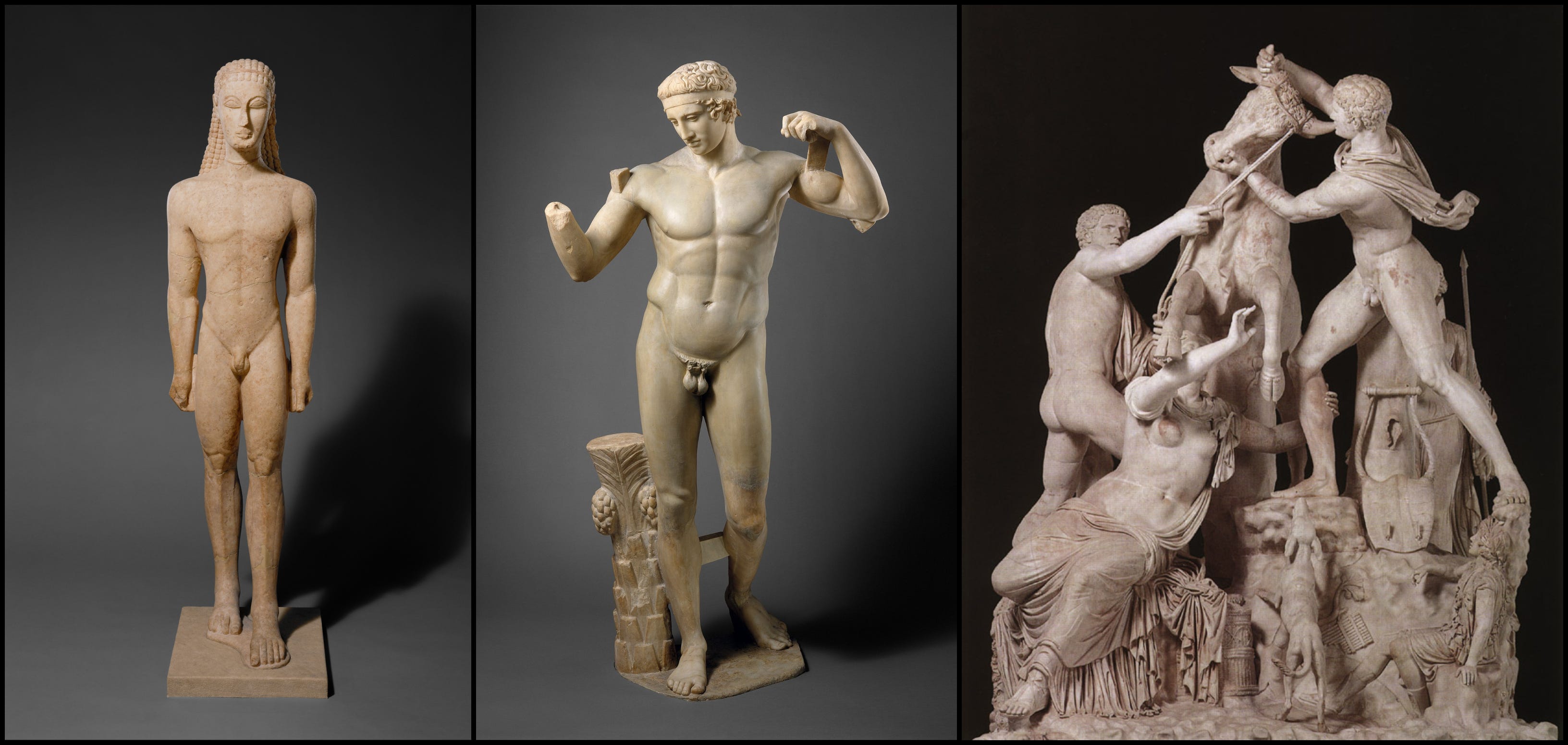
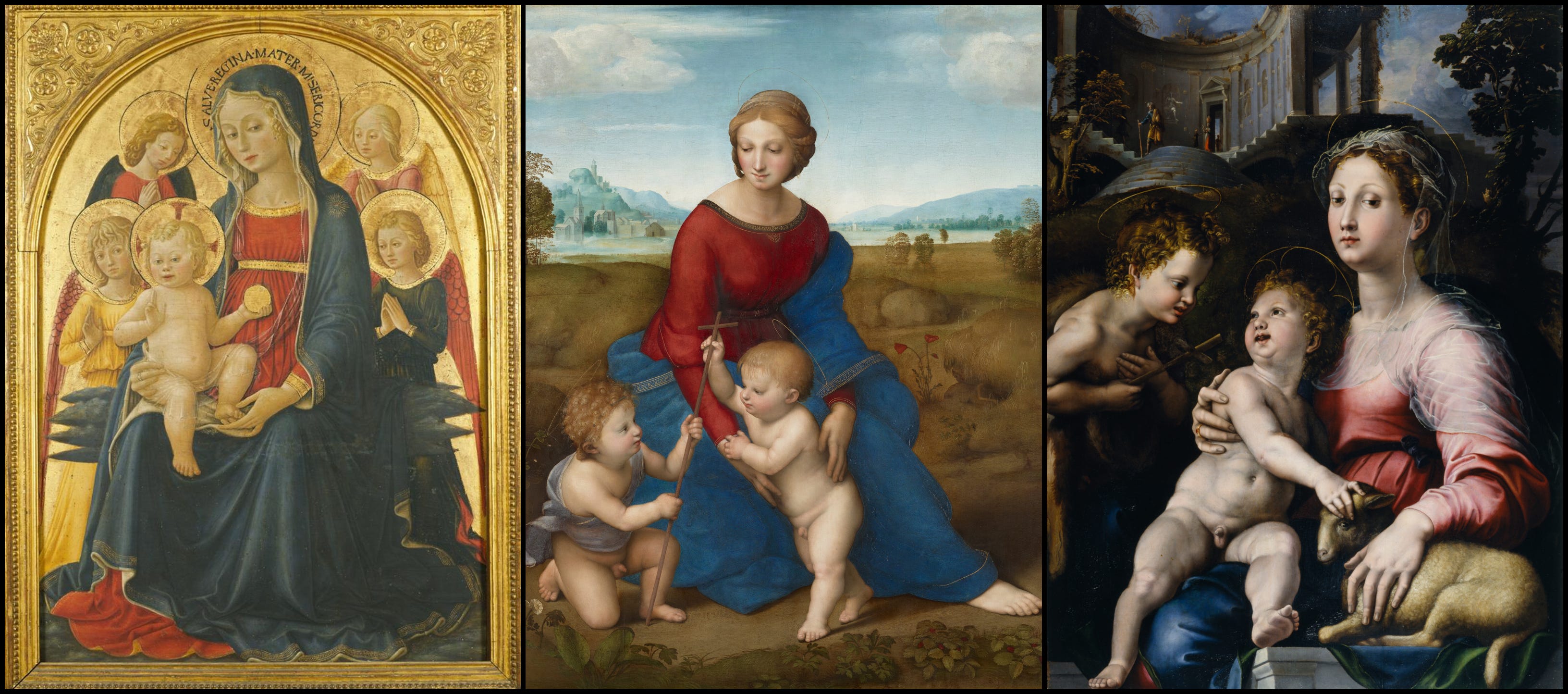
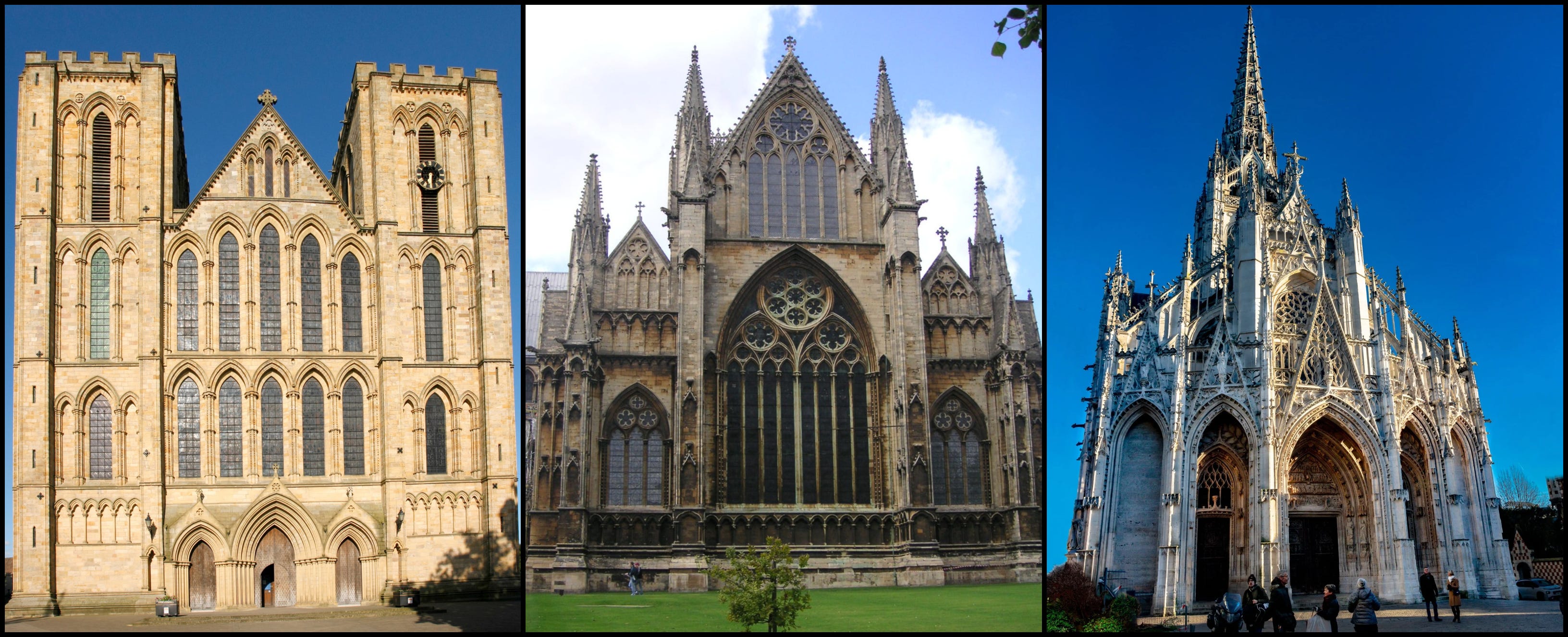
Any given artistic era can be divided into three distinct periods: the Archaic, the Classical, and the Decadent. Archaic Art is monumental, rudimentary, and vigorous. Classical Art is perfectly composed, lacking in nothing but also without superfluity. Decadent Art is elaborate and fantastical. You could also call these three phases Early, Middle, and Late, but I like the texture of Archaic, Classical, and Decadent.
In any case, examples will do more than words to explain what I mean. Look at the development of Greek statuary and you can see this progress very clearly. Three statues from the 6th century BC, 5th century BC, and 2nd century BC (this third is a Roman copy of a lost Greek original). In simple terms (and the simplest are usually best!) the first is rudimentary, the second is harmonious, and the third is dramatic.
Or we could look at the development of Renaissance art, where we see how quickly this arc of change can take place. Three paintings by Bartolomeo Caporali, Raphael, and Giulio Romano; one from 1450, one from 1506, and the other from 1524, each depicting the same thing. Severity evolves into serenity and collapses into melodrama.
This pattern also applies to buildings. Consider Gothic Architecture, which first emerged in the 12th century and lasted through to the 16th century. From left to right we have Early Gothic, Middle Gothic, and Late Gothic. Notice, as ever, the transition from simplicity (i.e. the tall, narrow windows) to completeness (larger windows, more complicated but nonetheless harmonious decoration) to extravagance (stone carved to look like lace, as if fluttering in the breeze):
You can zoom out and find this evolution taking place across centuries, or you can zoom right in and find it taking place across decades. It’s kind of like a fractal: the same pattern appearing however close you or however far you step back; every larger pattern is made up of identical, smaller versions of that same pattern.
The Internet is also experiencing this life-cycle; just think back to how simple the Internet once looked! Are we living through the Classical Age, or have we already become Decadent? I will leave you to decide. Even the Areopagus has undergone a similar evolution. The early volumes were extremely brief and very direct; they evolved into something more complete and harmonious; in more recent volumes I have been more experimental and elaborate.
Why do these three phases keep reoccurring across art? An idea, when newly formed and still forming, is very elastic and almost frenetic. The possibilities are endless because its limits have not yet been discovered. The simplicity of Archaic Design is therefore a consequence of untapped potential.
When that potential has been discovered and mastered we arrive at Classical Design. It feels composed and harmonious because the best and most effective way of doing everything has been thought out. Nothing could be taken away; nothing could be added.
Then, when an idea has reached its zenith, when everything has been figured out and perfected… what’s left to do? You can only elaborate on what’s already been done, which really amounts to little more than increasingly ingenious or impressive ways of repeating oneself. That’s Decadent Design.
And that brings us back to the silent era, and to Charlie Chaplin in particular. If you watch films from the early 1900s and 1910s they give the same impression as Archaic Art. There’s something rudimentary about them; the cinematic language we’re all familiar with — the way the camera moves; the way one scene flows into the next — was still nascent, and in some cases barely present. It can actually be quite jarring to watch these films, because they don’t do all that extra stuff (which we don’t realise is extra) that we’ve been accustomed to: scenes simply start, with the camera pointing at the actors, and they act. It has the style of news footage, with the simple purpose of recording what is happening. Consider Charlie Chaplin’s first appearance as “The Tramp” onscreen; it came in 1914, in a six-minute film called Kid Auto Races at Venice:
Despite this era’s simplicity you can sense the possibilities, you can sense all the different ways that things might evolve. Every single time the camera does something slightly new — panning, tilting — or the editing does something different — cross-fading, match-cutting — it feels like a revelation.
One doesn’t get quite the same feeling when watching new films. Cinema is an art that has been polished and perfected, taken almost to its limits. The camera tricks may get fancier, but they’re just variations of what we already know. That’s why, when something genuinely new does emerge (the rise of CGI, for example) it generates so much excitement. Back in the early days of cinema almost every single film did something new, and it could not have been any other way.
Most remarkable about silent films is how little time they waste. The lengthy opening sequences we expect of movies — establishing the characters, mood, and setting — are absent. At most there’s a single intertitle giving some basic facts; most often we jump straight into the action. Endings aren’t drawn out emotional affairs; we’ve seen the story, and so we fade to black swiftly.
All of this meant that, returning from silent films to the modern world of sound and CGI, I found myself surprised. All the talking — the constant talking — was annoying. What Chaplin would have conveyed with the flicker of his eyes now required a whole minute or two of subtext-laden dialogue. Modern films that once seemed fast-paced compared to films from the 1950s or 1960s now seem awfully slow in comparison to films from the 1920s. And even those films from the Golden Age of Hollywood, which we usually think of slower and less visceral, now seem decadent, elaborate, fast-paced, and full of artifice when compared with the 1920s.
So: what are the eras of cinema? It seems to me (though the lines always blur, and zooming in or out the patterns become broader or narrower in scope) that Archaic Cinema runs from its invention in the 1890s through to the early 1920s; thereafter began a Classical period that lasted until the 1950s, epitomised by Charlie Chaplin’s Modern Times Lights; everything since has been Decadent.
Of course, there are smaller arcs within this broader progression. In 1928 the arrival of “talkies” (as they were then know) represented a huge leap forward. In some ways it actually reset the development of cinema, because a whole new way of making films had been opened up. That’s why films from the 1930s can actually feel less developed, and more archaic, than films from the 1920s.
Similarly (as above-mentioned) the arrival of CGI and of digital cameras precipitated another partial reset, and therefore another arc of progression. If we compare CGI from its genesis in the 1980s through to 2026 then that familiar pattern emerges. People have often said that CGI seemed to peak about fifteen years ago and hasn’t really improved since, has rather become more elaborate or experimental.

The arts rise and fall together; each art lives and dies by the qualities peculiar to its own form, but they can all be understood by general trends and patterns. That’s why, instead of the paintings we usually look at, we have investigated the world of cinema. Our understanding of each is enhanced by comparing them. As Sir Philip Sidney said:
And why not so much the better, taking the best of both the other?
IV - Architecture
Dijon Cathedral
Rational Joys
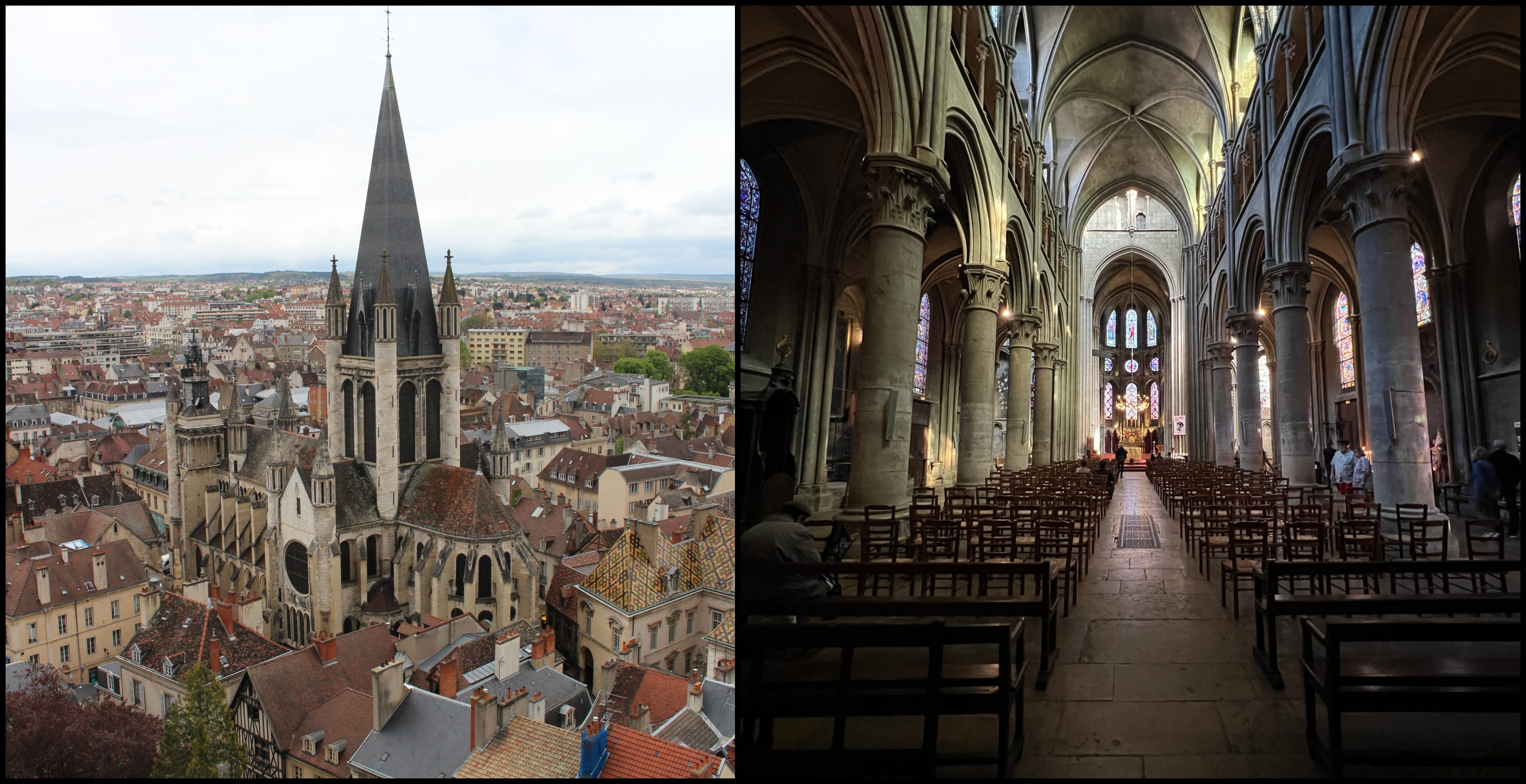
Dijon Cathedral (in Dijon, France) was built in the 13th century and restored in the 19th century; the cathedral as we see it today is a combination of these two periods.
They are the facts. But I want to ask: what do you see, when you look at this building? Our general conception of Gothic Architecture is one of fantasy. We see a monument of unfathomable majesty, a building-sized work of art that is surely, and above all else, a triumph of illimitable imaginative splendour! Audacious, magical, and exuberant.
But, in the middle of the 19th century, a Frenchman called Eugène Viollet-le-Duc saw something different. Our whole modern idea of restoring old buildings started with him; Viollet-le-Duc was also the most influential architectural theorist of the last two hundred years. Why so influential? Because he looked past mere outward forms and decoration — past the gargoyles of Gothic or the Corinthian capitals of Classical — and sought out rationality.
When he looked at Dijon Cathedral, Viollet-le-Duc saw was a very rational solution to a very specific problem: how, using limited resources, to create the largest space possible for people to gather. As he said:
At Dijon there exists a church of moderate size, under the name of Notre-Dame; it was built about 1220 and is a masterpiece of reasoning, in which the science of the builder is hidden under an apparent simplicity.
We recognize, moreover, that he must have been limited in expense and must have avoided useless expenditure. He was chary of the materials and did not use one stone too many.
How did he reach this conclusion, not only about Dijon Cathedral, but about Gothic in general? Well, one of the central tenets of Gothic Architecture is its vaulting:
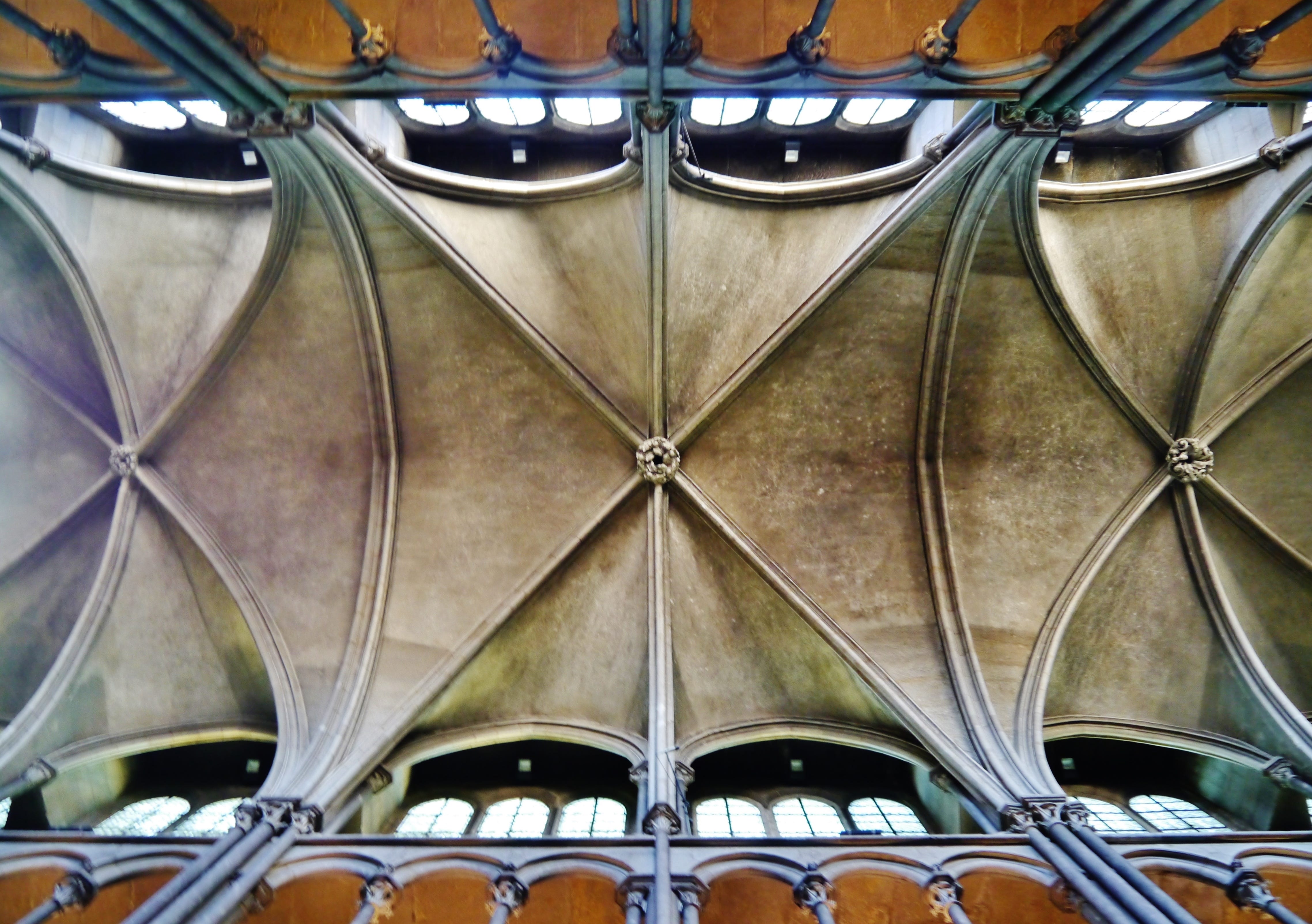
These vaults allow you to enclose very large spaces, but they produce a lot of lateral thrust, i.e. they are pushing outwards. It was to counter this thrust that buttresses were used; hence Gothic Cathedrals are lined with them, either connected to the walls (as on the left) or separated from them in the form of flying buttresses (as on the right):
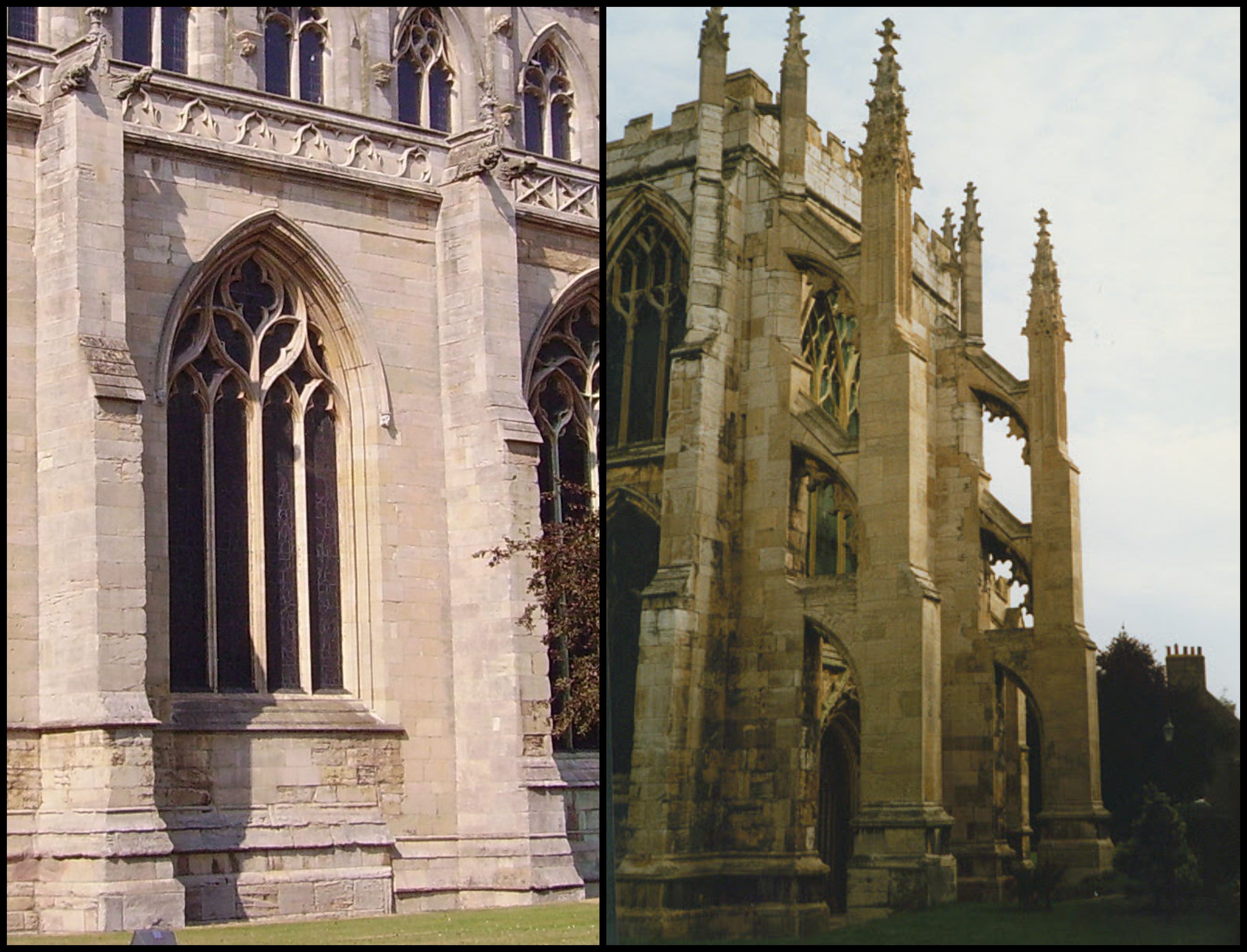
An alternative solution to covering the same amount of space would have been to use a different kind of roof that pushed downwards rather than outwards. This is how the Romans used to build. It is much more stable, but it also requires a great deal more stone, bricks, and other materials… and that makes it more expensive! And so, though it sounds hard to believe, Gothic Cathedrals are incredibly economical.
Flying buttresses epitomise our popular conception of Gothic Architecture as something fantastical and over-the-top, but the truth is that flying buttresses were robust way of building churches, and they required less stone. Furthermore, by taking on so much of the thrust, they allowed the walls of a church to be thinner, therefore making larger windows possible.
But when Dijon Cathedral was being built in the 1220s there wasn’t much room; the proposed site was very narrow and enclosed on all sides by houses. Thus the typical manner of building flying buttresses — which required more space — was cast aside, and the builders of Dijon Cathedral adapted them to an alternative solution. Viollet-le-Duc explains this for us:
We have already said that the architect of Notre-Dame at Dijon had at his disposal a limited area crowded in between narrow streets; so he could not give to the buttresses of the nave supporting the whole system a great projection beyond the perimeter of the aisles. If he had followed the methods adopted in his time, if he had remained submissive to routine, or, to be more accurate, to the rules already established by experience, he would have designed the flying buttresses of the nave as indicated in figure 28.
On the left is Figure 28, depicting a more typical flying buttress, as drawn by Viollet-le-Duc; on the right is Figure 29, representing the flying buttresses as actually constructed at Dijon Cathedral:
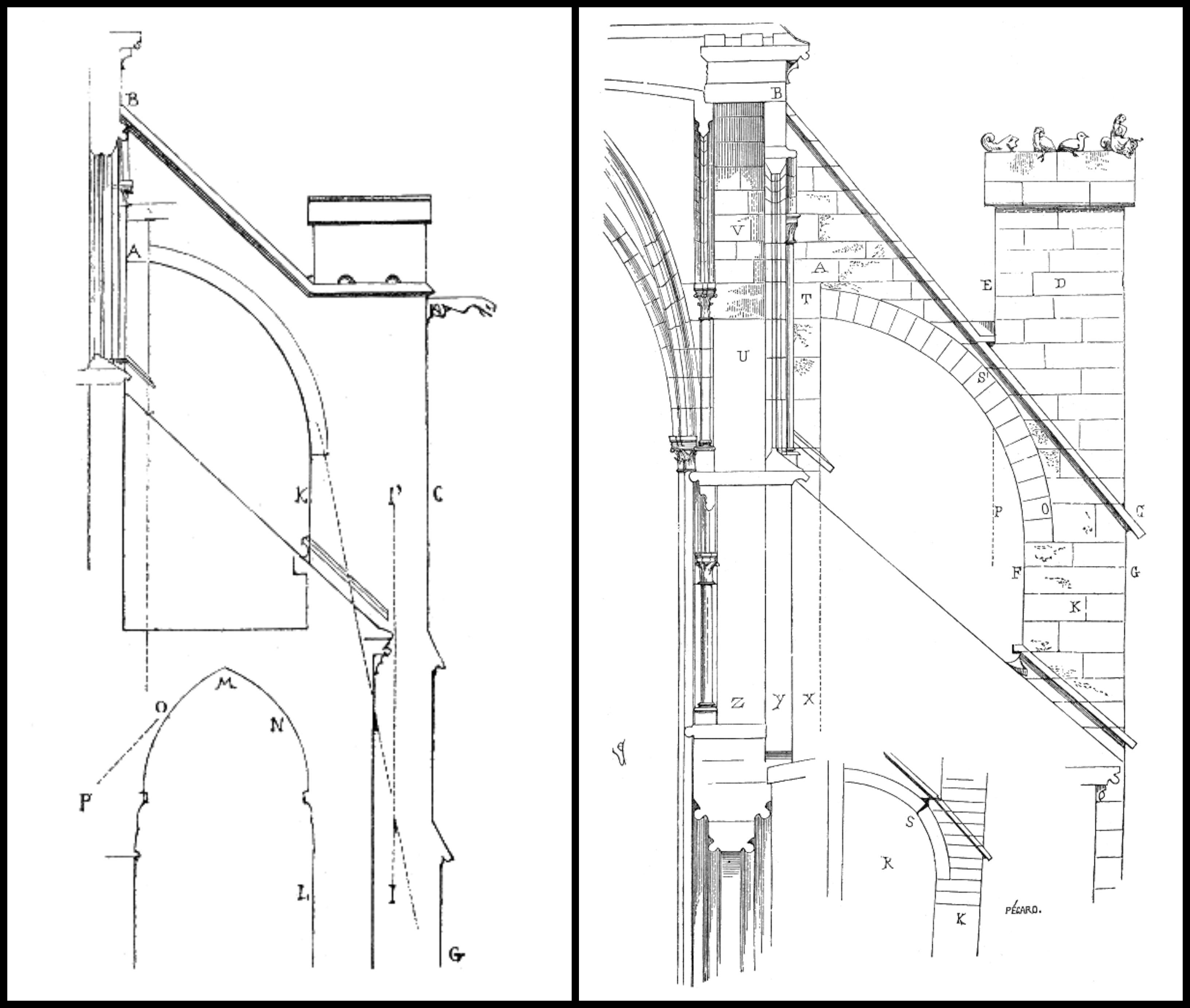
And here Viollet-le-Duc explains why it such an ingenious solution. Don’t worry about fully understanding his analysis; it is very technical and quite hard to follow. Nonetheless I think it is worth reading, if only to get a sense of how structurally complex these great Gothic cathedrals were, and how brilliant their masons, how adaptable and rational the style was. All the letters he used are in reference to Figure 29 (the image on the right of the two above this paragraph).
Let us notice that the vaults do not push directly upon the tops of the flying buttresses and that between the tops of these arches and the skewback of the vault there exists, above the triforium U, an interior support V just at the height of that thrust, neutralizing its action in a singular manner. Let us study the details: the block of stone T, against which the last voussoir of the flying buttress rests, is no other than the lintel carrying the support of which we were just speaking and at the same height as this lintel are fixed the two capitals that carry the wall arches of the vault. This lintel is set just on the level of the action of the thrust from the great vault.
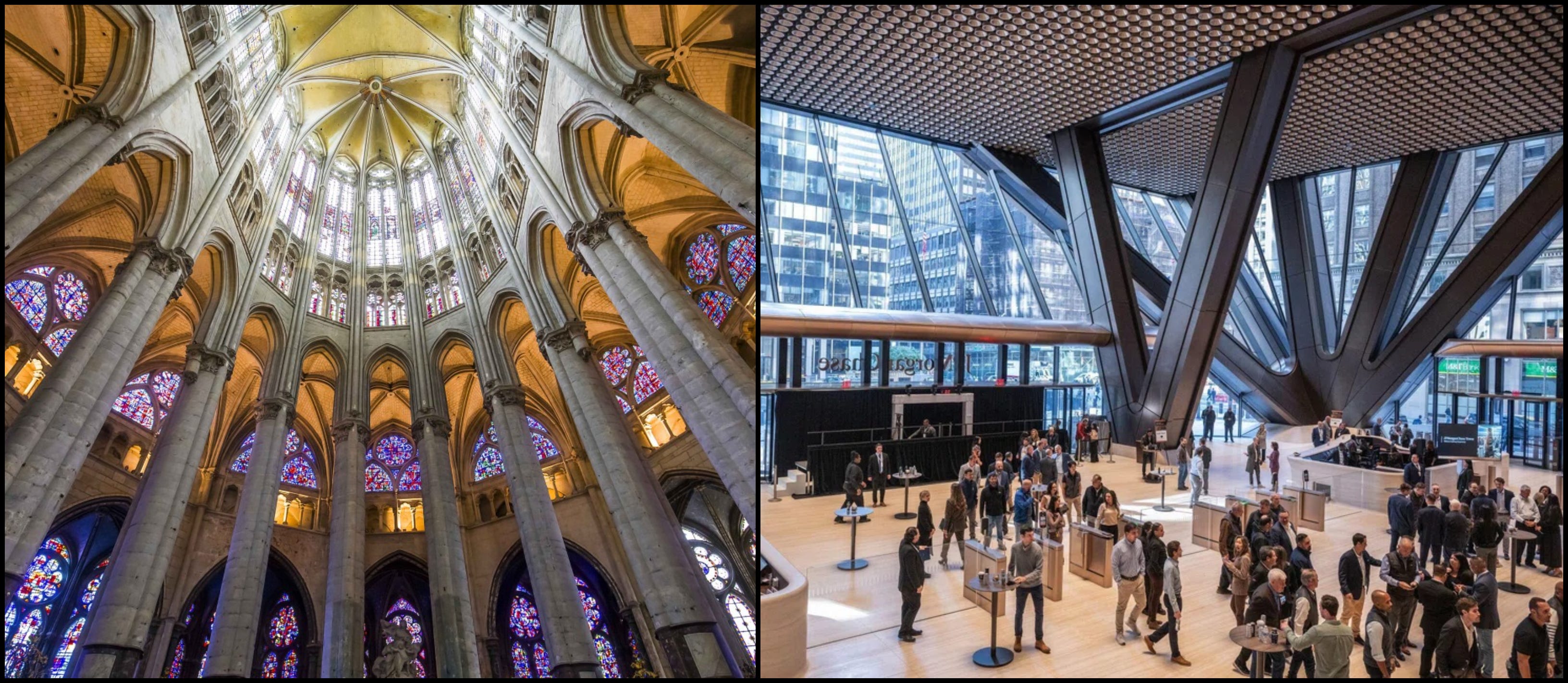
Partly because the era in which they were built is so distant, and partly because these Medieval masons so sublimely executed their chosen method, we find it very hard to realise that these great Gothic cathedrals have their entire structure exposed to us. They are essentially colossal and complicated networks of stone scaffolding, with the spaces between the scaffolding occupied by stained-glass windows. And this is exactly how we build today, the difference being that we use steel rather than stone.
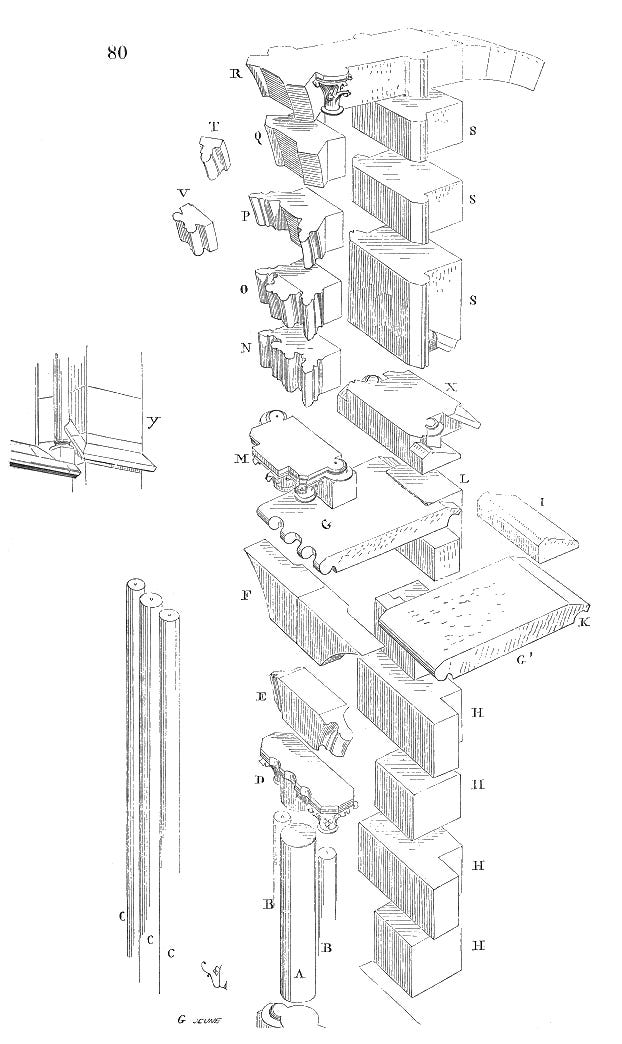
Thus Viollet-le-Duc was the first person to properly explain how all the flowing stonework hadn’t merely been for show, that every single block of stone was placed with intention and held a key structural role. It was only because Medieval stonemasons carved them to look pretty that think otherwise. Consider Viollet-le-Duc’s diagram of how the walls of the nave were constructed; we can now understand why he said that not a single stone was wasted!
I write all this not only because it is interesting in relation to Dijon Cathedral itself, and to Gothic Architecture as a style, but because it introduces an alternative way of looking at any building, from any era. Focus on a building’s structure, on how it’s actually holding together and standing up, and new details will be revealed.
If you’d like to read more of Viollet-le-Duc’s work, perhaps the best place to start is with How To Build a House. It takes the form of a story about a young boy who wants to build a house for his newly married sister, and lays out Viollet-le-Duc’s core principles and ideas, as applied to a specific scenario. You can read it online, for free, here.
As a final observation, and somewhat contrary to Monsieur Viollet-le-Duc, it must be said that mere rationality does not explain all of Gothic Architecture. The structure may have been perfectly rational (contrary to what we generally believe), but the urge to decorate it as they did — the floral carvings, the stained-glass windows, the sculptures — speaks to a different part of human nature. The best of what we do always unites them in perfect harmony; Gothic Architecture is, I think, exactly that.
V & VI - Rhetoric & Writing
Polytropos
[The Rhetoric and Writing sections of this Areopagus blurred into one as I wrote them; in which case it only made sense (not fearing (in true, rational, Gothic style!) the disruption of an established pattern) to combine the two sections.]
A new version of the Odyssey is coming out (in this case Christopher Nolan’s film adaptation; see the trailer here, if you haven’t already) and that means controversy. It’s nothing new. Although T.E. Lawrence (a.k.a. Lawrence of Arabia) said in the note to his 1932 translation of the Odyssey that
The twenty-eighth English rendering of the Odyssey can hardly be a literary event
we can chalk it up to his habitual understatement. There is no such thing as an uncontroversial, or at least uninteresting, translation (or adaptation) of the Odyssey. This is largely because both it and the Iliad formed the hard core of the Ancient Greek literary and religious worldview. And, by virtue of Greece’s uniquely oversized influence (via Rome) on all of subsequent history, they are both baked deep into the fabric of our society, even in places we don’t quite realise.
What controversies have there been? There was the question of whether Homer wrote his Odyssey or whether he was a poet whose work was passed down orally and only written down later. It is the second of these two suggestions that has become consensus, though not without a century of academic warfare.
And then there’s the oldest question… of authorship itself! Was Homer real? Perhaps. Some have said that Homer is really the ancient equivalent our word epic. In that case the name “Homer” might represent a long tradition of oral poetry (rather than a single individual) passed down through generations, reformulated at certain points by particularly brilliant poets, and finally written down when writing arrived in Greece.
Did the same person compose the Iliad and the Odyssey? It seems unlikely. The two works are so vastly different that we cannot reasonably imagine the same individual creating them both, nor even that they were created at the same time; the Iliad seems very clearly to be older. This has been the consensus for a very long time. But there have been challenges to it! Most famously, and essentially alone, there was the great novelist and translator Samuel Butler, who proposed that the Odyssey was composed by a woman. That was in 1897. He wrote a book laying out his view, titled The Authoress of the Odyssey, and in it said some remarkably modern-sound things:
Men seem unable to draw women at all without either laughing at them or caricaturing them; and so, perhaps, a woman never draws a man so felicitously as when she is making him ridiculous.
To his contemporary critics, who seemed to believe that no woman could possibly have done it, Butler says:
It may be urged that it is extremely improbable that any woman in any age should write such a masterpiece as the Odyssey. But so it also is that any man should do so. In all the many hundreds of years since the Odyssey was written, no man has been able to write another that will compare with it… Phenomenal works imply a phenomenal workman, but there are phenomenal women as well as phenomenal men.
And, drawing on the poem itself for evidence of his claim, argues:
The moral in every case seems to be that man knows very little, and cannot be trusted not to make a fool of himself even about the little that he does know, unless he has a woman at hand to tell him what he ought to do. There is not a single case in which a man comes to the rescue of female beauty in distress; it is invariably the other way about.
Further, pointing out differences between the Iliad and Odyssey that indicate not only a different author, but that the first was created by a man and the second by a woman:
…when there is any exhibition of domestic life and affection in the Iliad the men are dominant, and the women are under their protection, whereas throughout the Odyssey it is the women who are directing, counselling, and protecting the men.
You can read his quite remarkable book, online and for free, here.
Butler’s view has not really been echoed or even seconded, but to know that such conclusions have been drawn is to know that the Odyssey guarantees intrigue. To take any view on it whatsoever is to necessarily take a view that conflicts with what others have said and done.
Enough about the identity of Homer. Though, hereon, for the sake of ease, I will refer to “Homer” as the author of the Iliad and the Odyssey.
In a recent interview, Christopher Nolan said modern superheroes originate in the heroes of Ancient Greece. This is a comparison I also drew in my book — though, really, to point out the key difference between heroism as we conceive of it now and heroism as conceived by the Ancient Greeks — and one that has been made by many others. Readers of the Odyssey, looking for heroism as we think of it today, will find themselves disappointed.
There has been some criticism of the Greeks’ armour, specifically of Menelaus:

Anachronism is nothing new. Look at any Renaissance painting of scenes from the Odyssey and you’ll find its heroes dressed like Renaissance gentlemen. Consider Pinturicchio’s 1508 painting of Odysseus’ return to his home on Ithaca:
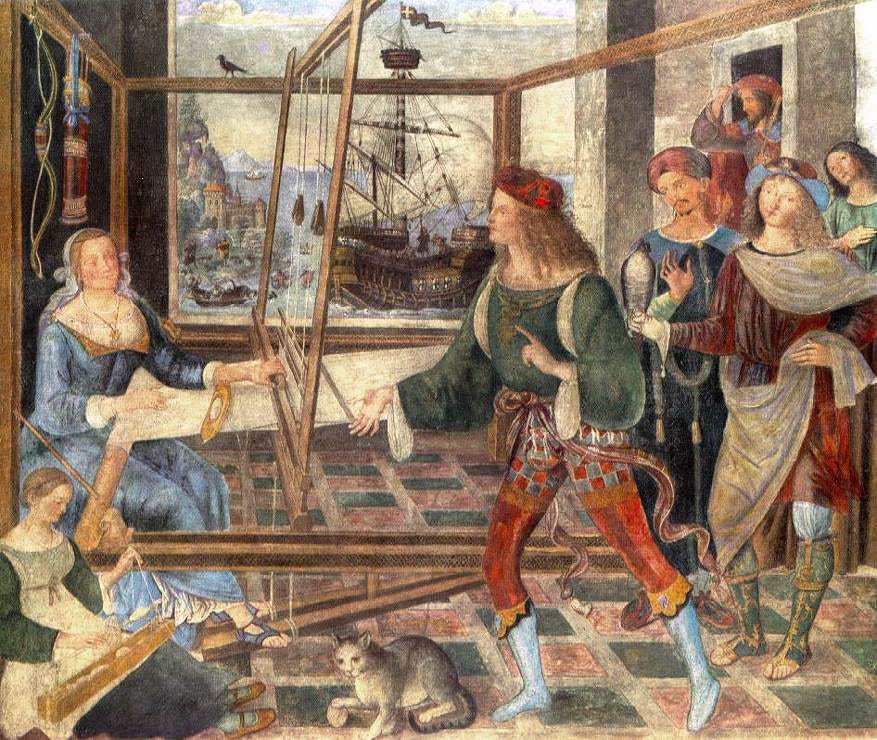
The Ancient Greeks certainly didn’t dress in that fashion, and nor do those ships look remotely like the ships of Odysseus and his countrymen. If Nolan’s adaptation has been accused of changing the source material to suit the present day, then this accusation must also be levelled at essentially every recreation of the Odyssey, in whatever form, since Antiquity. Yes: since Antiquity itself, since the very days of the Ancient Greeks themselves!
See, the Odyssey as we know it dates back to the 8th century BC, which was a full three hundred years before the Greek era we are most familiar with: of democratic Athens, of Socrates, Pericles, and the Parthenon. In his Aratra Pentelici John Ruskin makes the fabulous observation that we wrongly associate Greek art of the 5th century BC with the Iliad and the Odyssey. This sort of thing is that comes to mind for us: an impossibly lifelike, divinely genericised marble statue of Athena, who presides over Odysseus during his journeys:
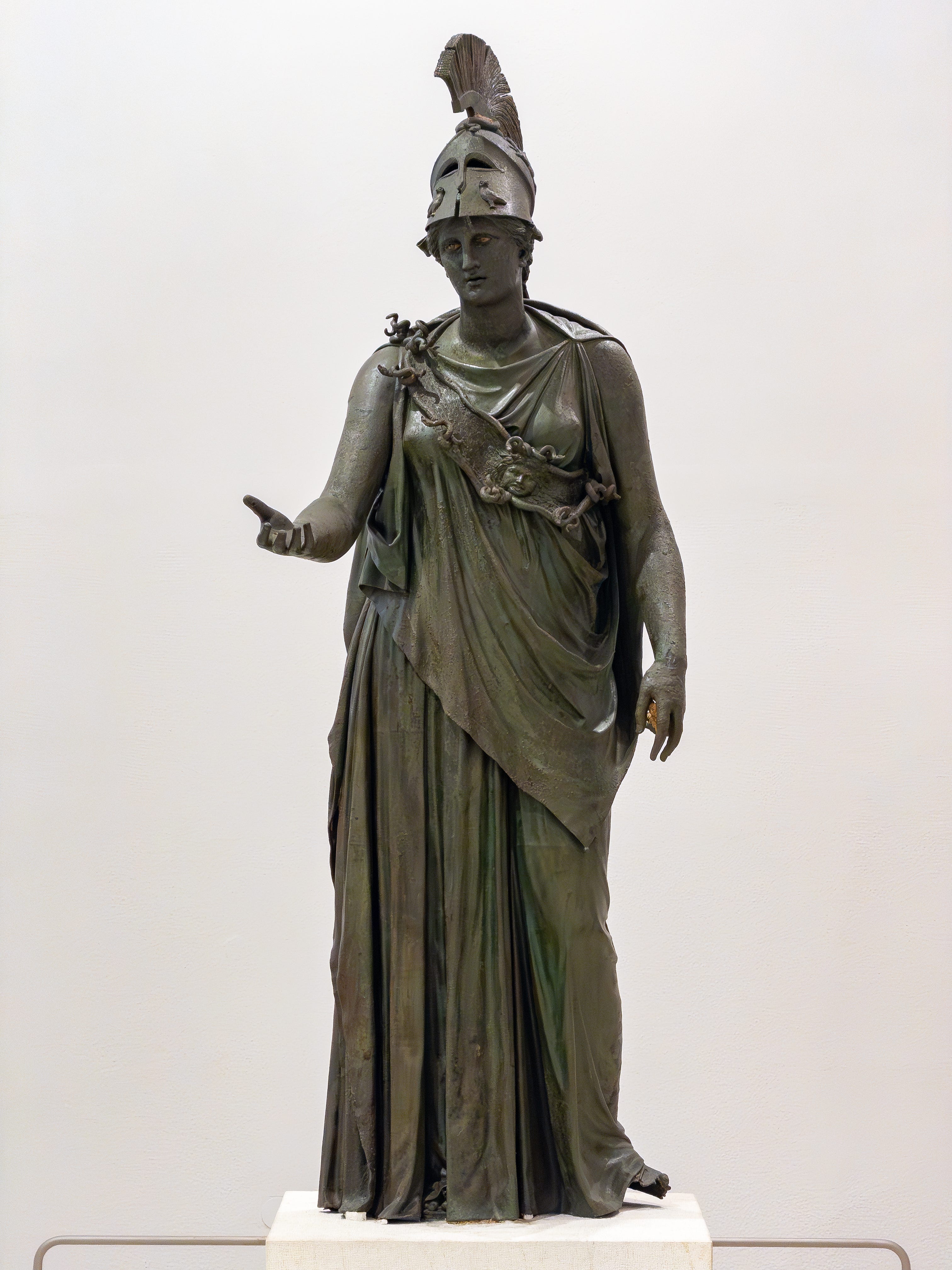
But if we look at Greek art contemporary with Homer, or at least closer in time to his proposed life, then we will be surprised to see how rudimentary it is. Here we see, once again, that divine guide Athena. Only, we may say, looking somewhat less divine:
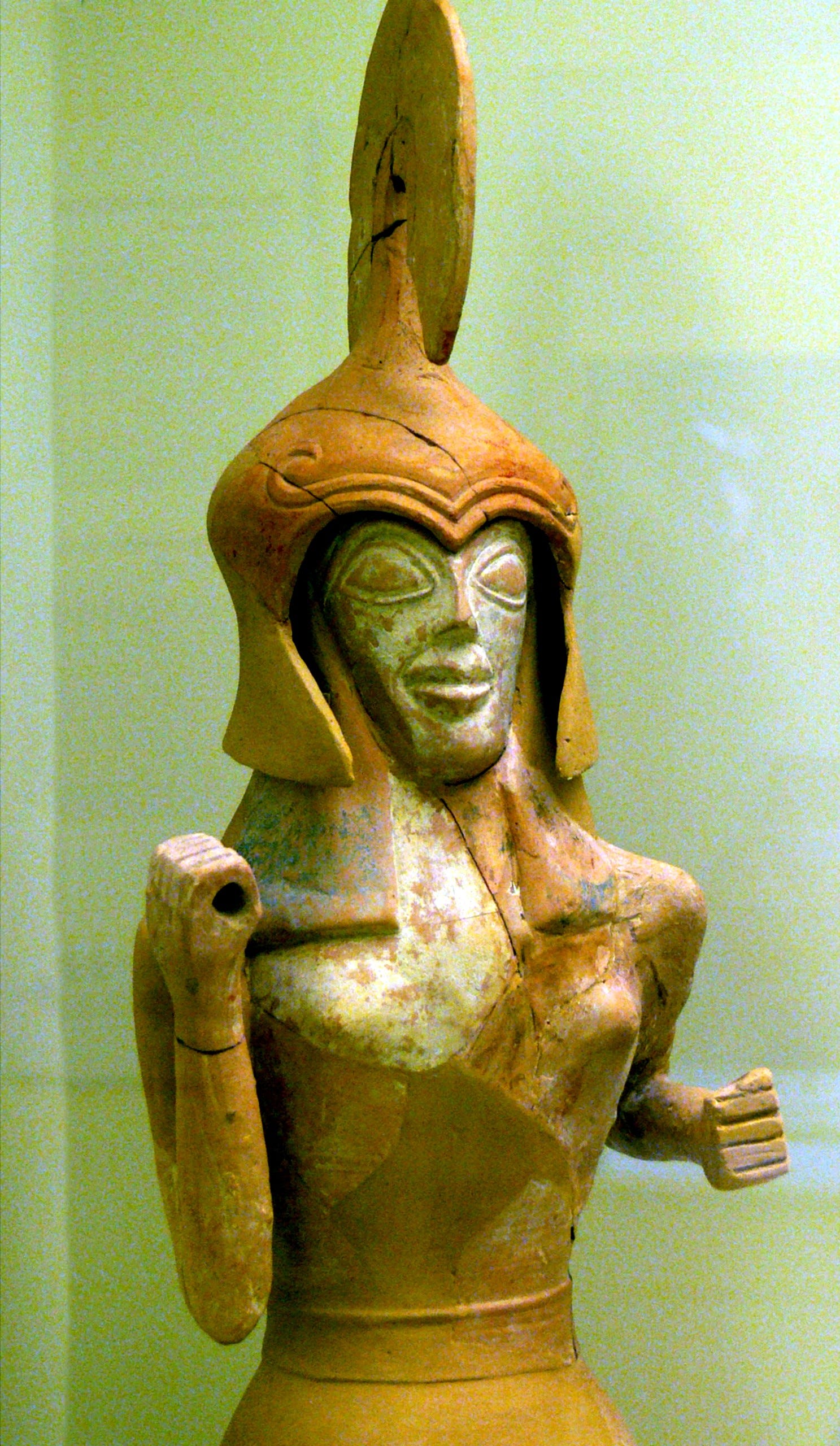
It was in view of comparisons like these that Ruskin said:
The inconsistency between an Homeric description of a piece of furniture or armor, and the actual rudeness of any piece of art approximating, within even three or four centuries, to the Homeric period, is so great, that we at first cannot recognize the art as elucidatory of, or in any way related to, the poetic language.
That peculiar statue is the closest thing to an ancient equivalent of our modern film adaptations, i.e. giving visual form, whether in clay or on the screen, to the poetry. And, looking at it, we find ourselves… shocked? We learn, instantaneously, that the Homeric age was radically unlike ours. And so Nolan’s adaptation is hardly less anachronistic those fabulous bronze or marble statues made in the age of Pericles; to adapt is, necessarily, to anachronise.
All of which brings us to the poem itself, and to its famous first line, which introduces the protagonist. Odysseus is described in the Odyssey’s first words as polytropos. What this word means, which doesn’t have a perfect English equivalent, has been debated for centuries.
Emily Wilson, whose 2017 translation of the Odyssey was used as the basis for Nolan’s film, translated polytropos as “complicated”. Her opening lines run thusly:
Tell me about a complicated man.
Muse, tell me how he wandered and was lost…
What else have translators gone for? Through all the quotes given below I have placed in italics the word or words that correspond to polytropos.
George Chapman (made famous by John Keats’ poem) translated it like this back in 1615, as he put together the first ever translation of the Odyssey into English:
The man, O Muse, inform, that many a way
Wound with his wisdom to his wished stay…
Alexander Pope (1725):
The man for wisdom’s various arts renown’d,
Long exercised in woes, O Muse! resound…
William Cowper (1791):
Muse make the man thy theme, for shrewdness famed
And genius versatile…
Henry Cary (1823):
O Muse, inspire me to tell of the crafty
man, who wandered very much…
William Cullen Bryant (1871):
Tell me, O Muse, of that sagacious man…
Arthur Sanders Way (1880):
The Hero of craft-renown, O Song-goddess, chant me his fame…
Even William Morris (who was, we should remember, more famous in his own lifetime as a poet rather than a designer) translated the Odyssey, going for this in 1887:
Tell me, O Muse, of the Shifty, the man who wandered afar.
Samuel Butler (1900):
Tell me, O muse, of that ingenious hero…
Robert Fagles (1996):
Sing to me of the man, Muse, the man of twists and turns…
A.T. Murray (1919):
Tell me, O Muse, of the man of many devices…
T.E. Lawrence chose, in 1932:
O Divine Poesy
Goddess-Daughter of Zeus
Sustain for me this song
Of the various-minded Man…
Robert Fitzgerald (1961):
Sing in me, Muse, and through me tell the story
of that man skilled in all ways of contending…
E.V. Rieu (in a revised 1991 edition):
Tell me, Muse, of that resourceful man…
Simon Armitage (2006):
Remind us, Muse, of that man of many means…
That single word, polytropos, has been rendered into English dozens of times, and always differently, either because of the intentions of the translator or the times they were living through. William Morris’ “the Shifty” is certainly quite unusual; Bryant’s “sagacious” seems very different to Cary’s “crafty”; and Way’s “craft-renowned” feels of its time. So who was Odysseus? Was he wise (as Pope would have it) or shrewd (as Cowper preferred)? Do those words mean the same thing? And what about words that mean something different now to what they did twenty or two hundred years ago?
It is a minefield, an evolving situation that seems to require different methods of management in any given era, rather than a fixed problem with a lasting solution.
Perhaps the most important question is this: what precisely do we expect from a story first told three thousand years ago? It is a strange and brutal tale that does not match the methods or morals we expect in modern films, books, poetry, or TV. Odysseus is the protagonist, but he is not the “hero” in any current sense of the word. Anybody who has read the poem will find its culmination shocking. But “good” and “bad” as we think of them now didn’t exist in the Homeric worldview. The Romans (who called him Ulysses) disliked Odysseus for his role in the destruction of Troy, from which they believed their society to be descended. During the Middle Ages, when Dante wrote his legendary Divine Comedy, Odysseus was placed in the eighth circle of Hell!
How will Nolan’s adaption deal with him? Not like Dante, I suspect. The question is whether “good” and “bad” will be part of it, as they are not in the original poem, but as everybody since has imparted them. Will Odysseus be hero? Will he even be likeable?
And so I return to T.E. Lawrence’s translation, and in particular to his translator’s note (which I have mentioned before the Areopagus, and which has become timely once again). Rarely do we find commentators willing to criticise the Odyssey. There is something empowering about Lawrence’s withering assessment of the great poem; empowering not because we agree with him, but because opening it up to criticism makes it a living thing for us, no longer a dead and untouchable monument:
Crafty, exquisite, homogeneous—whatever great art may be, these are not its attributes. In this tale every big situation is burked and the writing is soft… The author misses his every chance of greatness, as must all his faithful translators.
Lawrence’s refusal either to adapt his heroes for a modern audience or to fall back on uncritical worship of the distant past is striking. In some sense it pleases nobody, because most of us want (and expect) one or the other. Instead, Lawrence says:
…only the central family stands out, consistently and pitilessly drawn—the sly cattish wife, that cold-blooded egotist Odysseus, and the priggish son who yet met his master-prig in Menelaus. It is sorrowful to believe that these were really Homer’s heroes and exemplars.
A straightforward film adaptation of the Odyssey would be something! Watching it, we would surely react as Lawrence did when tackling the original Greek: with a mixture of revulsion and fascination, and above all a realisation that we are grappling with something so distant that we should not, perhaps, try to make sense of it whatsoever. At the very least, Lawrence says, we shouldn’t be afraid of simply disliking the “heroes” of this strange, ancient story.
That’s one view. But we end this section with another view: John Keats’ 1816 poem On First Looking into Chapman’s Homer. It records his feelings after having read George Chapman’s translation of the Odyssey; Keats felt for the first time that he understood those ancient days, and that — despite having heard about them so many times before — their majesty was at last revealed to him:
Oft of one wide expanse had I been told
That deep-brow’d Homer ruled as his demesne;
Yet did I never breathe its pure serene
Till I heard Chapman speak out loud and bold:
Then felt I like some watcher of the skies
When a new planet swims into his ken…
Shall we be as Lawrences, or as Keatses, when this new film arrives in our motion picture theatres? Far more has been said about the Odyssey than is said in the poem itself; another chapter in this book of ages is being written; many more shall be written hereafter.
VII - The Seventh Plinth
Newsletters Now & Then
The world is full of newsletters; our inboxes are overflowing with them. Mine will likely be one of dozens you receive each week, solicited or otherwise. And this feels like a modern phenomenon. That’s partly because we know very little about the past, and partly because any new technology (i.e. the Internet) always makes everything related to it feel new. But the truth (as ever) is that next to nothing is genuinely new.
My favourite past-time is seeking out startling similarities between past and present. Too many things are described as “unprecedented” when they are, as a matter of hard fact, deeply precedented. And that itself is also nothing new! Every historical chronicler describes the events they are recording as the worst, best, most dramatic, most shocking, most glorious things that have ever happened. Every new technology is greeted by a tidal wave of commentary predicting doom for humankind or at least some sort of civilisational upheaval. And, among that great sea of similarities between past and present, newsletters are a minor but wonderful case.
So, I suppose there are five kinds of modern newsletter:
Community (i.e. a newsletter sent to members of a particular group, whether a local organisation or charity)
Sales (i.e. companies send out newsletter with their latest offers, deals, and product updates)
Internal (i.e. members of a workforce receiving general workplace updates or important information relating to their work)
Actual news (i.e. newspapers and media organisations sending out “briefings” with short summaries of recent news and links to full articles)
Personal (i.e. like the Areopagus, where a specific individual writes a daily, weekly, or monthly piece; most of Substack is like this)
There are probably some other categories of newsletter, but these are the five that seem (to me) most common and familiar. And so the question is: can we find historical equivalents for each of them?
Community
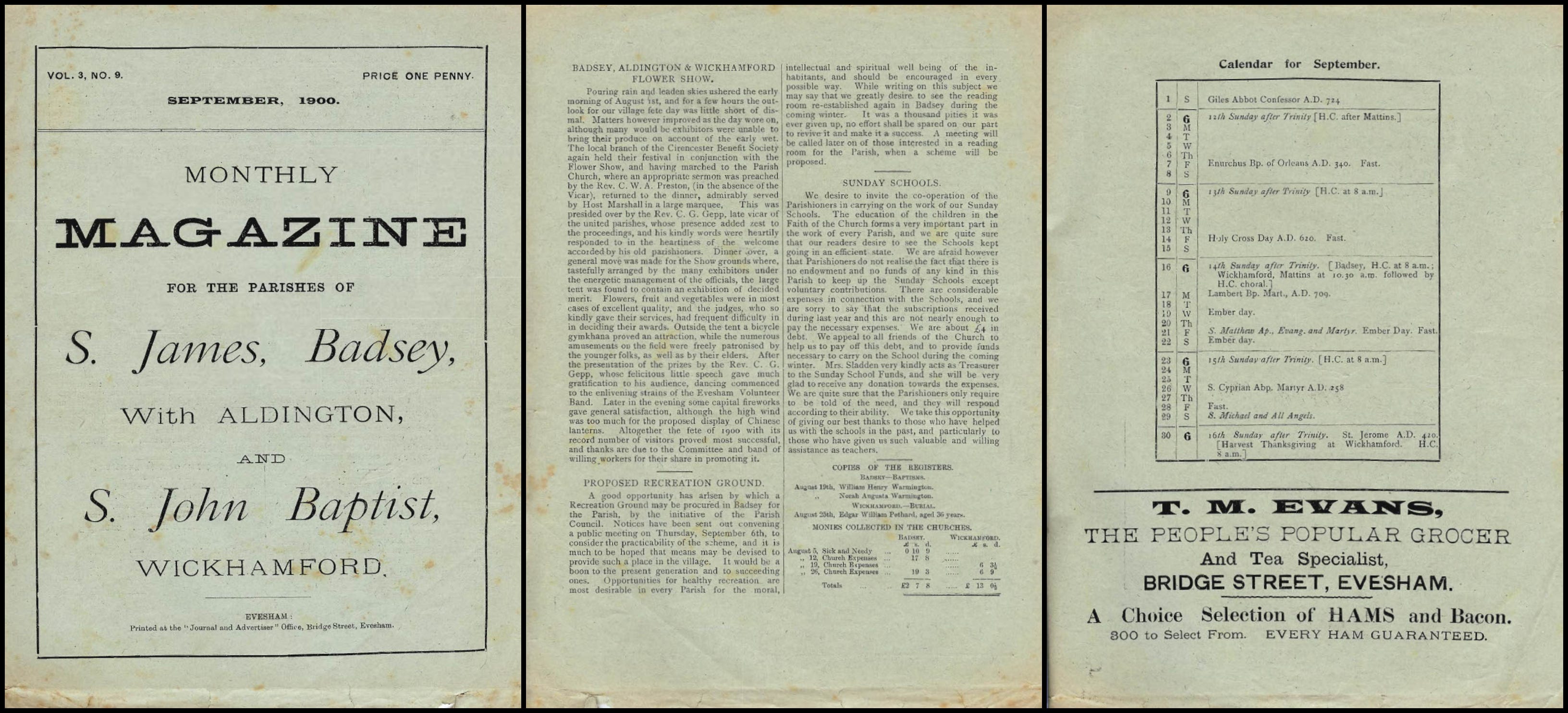
We have lots to choose from here, with examples going all the way back to the Middle Ages and, even, to Roman times. But I have gone for a somewhat humbler and simpler example, likely familiar in its modern form to many readers: the parish newsletter. These became incredibly common in the late 19th century, and one such case is The Monthly Magazine for the Parishes of S James, Badsey with Aldington, & S John Baptist, Wickhamford, first published in 1898. Every single volume (with the exception of the first!) is available online at this fabulous blog run by The Badsey Society.
This was the September 1900 volume, which includes information about a local show, a proposed recreation ground, and the parish’s Sunday Schools. Also: note the advert at the bottom of the third page for a grocer and tea specialist. Then, as now, newsletters relied on sponsorship!
Sales
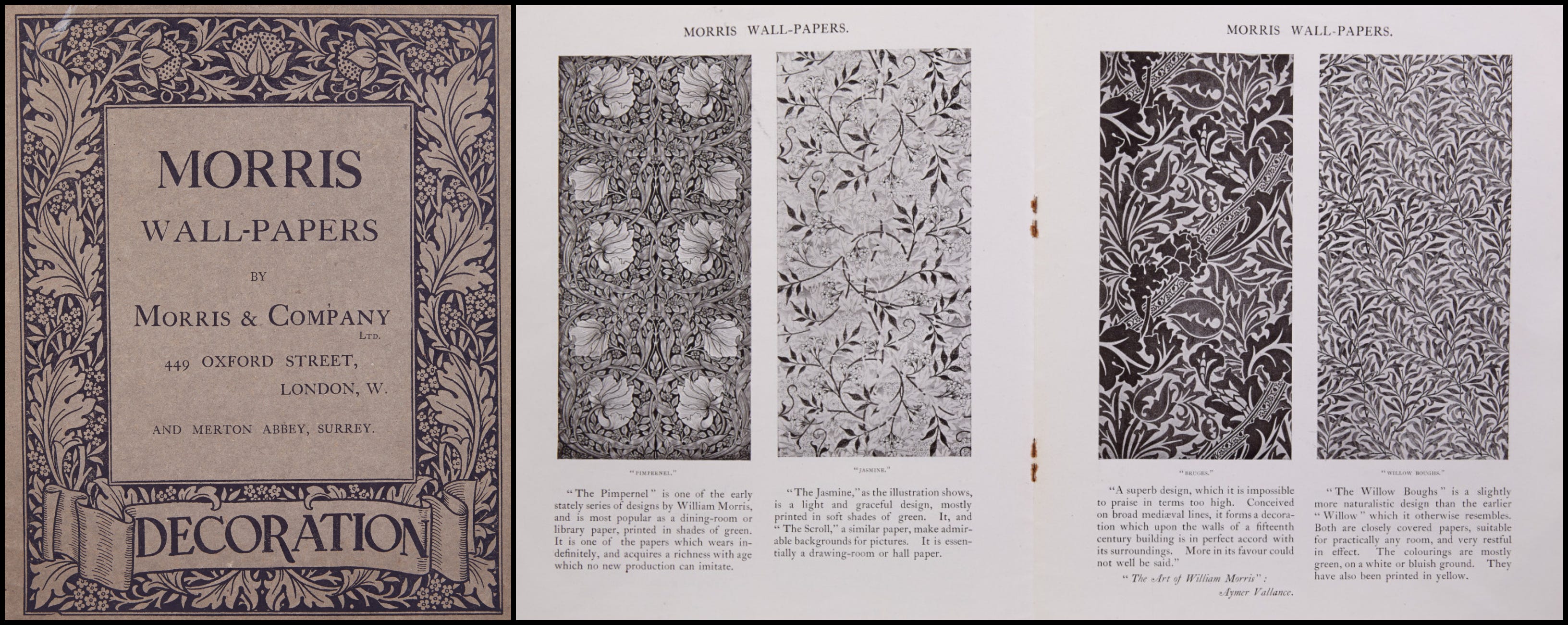
It was during the late 19th century, with the rise of our modern consumerist culture, that sales ‘newsletters’ first appeared. These largely took the form of catalogues mailed directly to customers. Marketing has since become more sophisticated, or at least more scientifically and psychologically precise, but the principle remains the same: a company is informing its customers of their newest products.
A particularly beautiful example is this 1913 catalogue produced by Morris & Co. (i.e. the company founded by William Morris), featuring a range of classic and brand-new textile designs:
Internal
Internal company newsletters go back a very, very, very long way. They might even be the oldest form of newsletter; even during the Late Middle Ages pamphlets were distributed to members of particular guilds (mainly merchants) with crucial information regarding the price and availability of relevant goods.
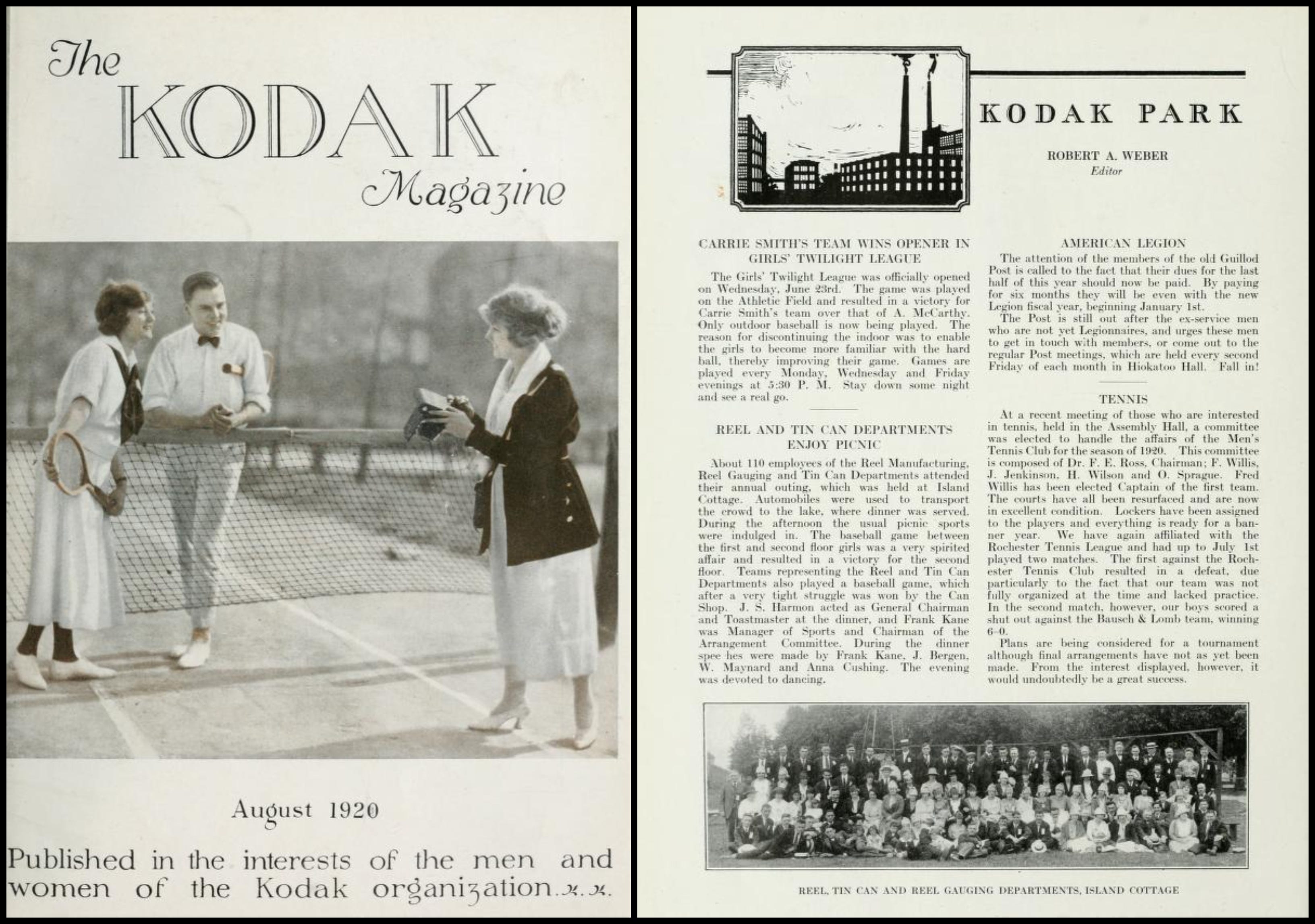
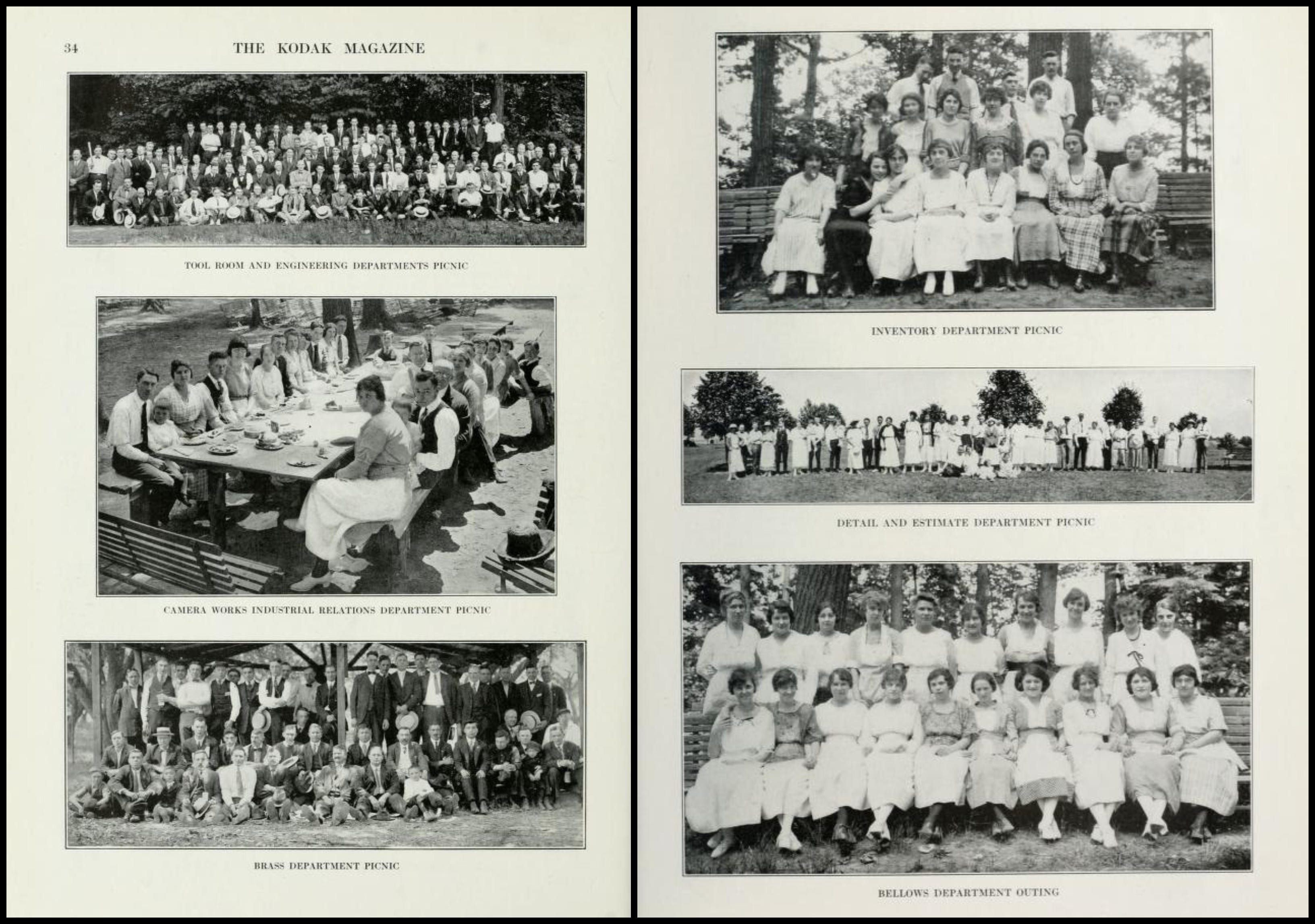
But internal company newsletters as we think of them today (featuring everything from updates about new staff and notes from the CEO to information about company societies, sports teams, and awards) really got going in the 19th century, when modern workplace culture itself started to emerge. A wonderful example, albeit slightly later, is the Kodak Magazine, produced for employees of the camera and film manufacturers Kodak. Here is the front cover and opening articles of the August 1920 volume:
And here are photographs from picnics held by various departments within the Kodak:
And, finally, most humbly of all:

Actual news
The line between newspaper and newsletter is not totally clear. Nonetheless I think we can distinguish between them (in an unscientific, non-academic, merely colloquial way) on the grounds of length and depth. If a newspaper is long and explains events in detail, then a newsletter is brief and tends towards summary.
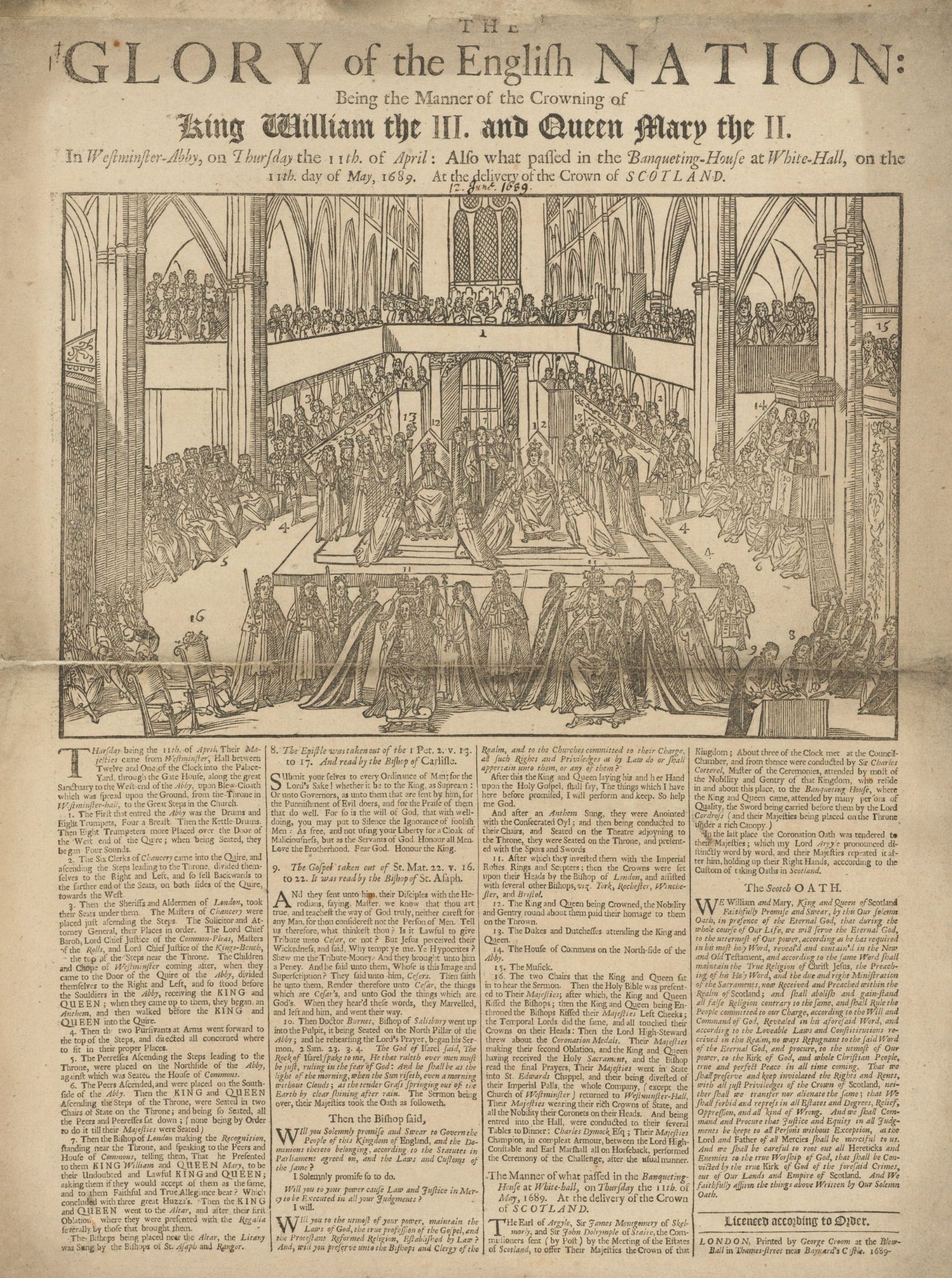
“Broadsides” were large sheets of paper printed on one side. Because of their cheapness, ease of manufacturing and distribution, and simplicity of content, broadsides were published in their millions from the 16th through to the 19th century. Official announcements from the government, new laws, advertisements, songs, sales, auctions, circuses, obituaries, meetings, slander, funny pictures; all of this (and more) was printed in broadside. And, amongst all that, brief summaries of recent events, which is the historical equivalent we’re looking for. Like this broadside, which gives an account of the marriage of King William and Queen Mary of England in 1689, along with a picture of the day’s events. Notice that the picture has been numbered; in the text you can find a description of who or what these numbers relate to.
Personal
This one is very simple: there are hundreds of historical precedents. The first that comes to mind is Dr Johnson, the legendary lexicographer and man of letters who compiled the first truly comprehensive English dictionary in the 18th century. One of his regular publications was The Idler, a short essay published weekly from April 1758 to April 1760, making one hundred and three essays in total, on the subject of whatever happened to interest him that week.
From Number 30, entitled The Corruption of News-writers, we find this lament:
No species of literary men has lately been so much multiplied as the writers of news. Not many years ago the nation was content with one gazette; but now we have not only in the metropolis papers for every morning and every evening, but almost every large town has its weekly historian.
And, in Number 7, a similar
Thus journals are daily multiplied without increase of knowledge. The tale of the morning paper is told again in the evening, and the narratives of the evening are bought again in the morning. These repetitions, indeed, waste time, but they do not shorten it. The most eager peruser of news is tired before he has completed his labour…
Even more familiar is Number 11, which begins with this famous line:
It is commonly observed, that when two Englishmen meet, their first talk is of the weather; they are in haste to tell each other, what each must already know, that it is hot or cold, bright or cloudy, windy or calm.
Admittedly Dr Johnson’s Idler was published as part of a larger newspaper called the Universal Chronicle, and so it might be considered more of a weekly column than a newsletter. But one of his previous essay series, called The Rambler, was published twice weekly from March 1750 to March 1752 as a standalone pamphlet. What could we call this if not the 18th century equivalent of a modern blog or Substack? It was very similar to The Idler; consider this, from Number 98, on the subject of politeness:
Politeness is one of those advantages which we never estimate rightly but by the inconvenience of its loss. Its influence upon the manners is constant and uniform, so that, like an equal motion, it escapes perception.
…
But as sickness shews us the value of ease, a little familiarity with those who were never taught to endeavour the gratification of others, but regulate their behaviour merely by their own will, will soon evince the necessity of established modes and formalities to the happiness and quiet of common life.
Both The Idler and The Rambler reward reading. By virtue of having been highly personal essays, rather than concerned primarily with contemporary news, their relevance has hardly dimmed at all. You can read both, online and for free, here.
As another example of the personal newsletter (i.e. a Substack) there was also John Ruskin’s Fors Clavigera, published monthly from 1870 to 1878, and then irregularly from 1880 to 1884. These took the form of letters, each about 6,000 words in length, “addressed to the Workmen and Labourers of Great Britain”. As was Ruskin’s way, any given letter of Fors Clavigera was ostensibly about one thing (e.g. birds, economics, recent art exhibitions, or King Richard II) but, really and inevitably, about everything.
You can also read Fors Clavigera online, and for free, here.
***
Five kinds of 21st century letter with historical precedents for all of them, and only the surface of this vast topic scratched! For now, at least, we can conclude that somebody’s physical inbox during the 19th or early 20th century would likely have resembled our digital inboxes, filled with short publications sent by community groups, employers, companies, journalists, and essayists. Plus ça change and all that!
And that’s all
The Sun was up in the cloudless sky… and has fallen away beyond the western horizon. Hot Summer darkness — or, truthfully, the more nostalgic darkness of Late Spring — has descended on Earth. What now, in the extended and immaculate blue silence? If you like to read on evenings like these then you will delight in this gorgeous poem by Wallace Stevens, putting judiciously into words the peculiar, wistful, fairytale magic that only emerges once or twice a year, when contemplating printed pages in long, deep, hot, twilight quietude:
The house was quiet and the world was calm.
The reader became the book; and summer nightWas like the conscious being of the book.
The house was quiet and the world was calm.The words were spoken as if there was no book,
Except that the reader leaned above the page,Wanted to lean, wanted much most to be
The scholar to whom his book is true, to whomThe summer night is like a perfection of thought.
The house was quiet because it had to be.The quiet was part of the meaning, part of the mind:
The access of perfection to the page.And the world was calm. The truth in a calm world,
In which there is no other meaning, itselfIs calm, itself is summer and night, itself
Is the reader leaning late and reading there.
Among all the work I’m doing I can only promise to dedicate as much time as I can to this newsletter; as much time, and even more of my Love. Adieu!
Yours,
The Cultural Tutor